The formula, and the denominator most “yield” claims leave out
A gross yield is annual gross rent divided by the total money it took to own the income-producing asset. For a new-build rooming house that total is the land, the build, the land transfer duty on the land, and the holding costs from settlement of the land to the first rent day — interest during the build, land tax if you own the lot at midnight on 31 December, council rates and the levy on the rates notice. Leave any of those out and the fraction still computes, but it no longer describes the investment you actually made.
The common shortcut divides the room rent by the build cost. It flatters the result because the land — usually half or more of the total in Melbourne — disappears from the denominator. In the illustrative scenario worked below, the all-in denominator ($700,000 land + $700,000 build + $37,070 duty, before holding costs) is $1,437,070, which is 2.05 times the build cost alone; whatever figure a build-only division produces, the honest figure is roughly half of it. That one choice explains most of the gap between a marketing number and the number a valuer reads on completion, which the financing article covers.
- —Numerator: weekly room rent × rooms × 52, then minus vacancy and every operating cost below — that is net operating income, the only figure worth dividing.
- —Denominator: land + build + duty + holding costs. Duty is paid on the land, not on the build; add conveyancing, permit, survey and service-connection costs if you want the complete picture.
- —Two answers, both useful: gross (before costs, on the same denominator) tells you what the market pays for room stock in that suburb; net (after every operating line) tells you what is left before interest and tax.
Gross income: room rent × rooms × 52 — and where a real room rent comes from
The first input is the weekly rent for one room, and it is the one that moves the answer most. A room in a registered rooming house is priced on what it includes — ensuite or shared bathroom, furnished or not, bills included or not — and on the suburb. The evidence to use is current advertised rents for comparable rooms in the same suburb, a written appraisal from a manager who runs rooming houses rather than a standard residential agent, and, as a check on the suburb, the whole-dwelling medians Homes Victoria publishes each quarter from Residential Tenancies Bond Authority bond data.
Multiply by the room count and by 52 only after deciding what “fully let” means. In the illustrative scenario used in this site’s films — nine rooms at $380 a week — the fully-let gross is $3,420 a week, or $177,840 a year, before a single deduction, which is exactly what the film disclaimer says. A rooming house in Victoria is defined by occupants, not leases: Residential Tenancies Act 1997 s 3(1) — one or more rooms available for rent and four or more people may occupy them. The rules article covers what the building must contain to be let that way.
Two rent rules shape the income line. Consumer Affairs Victoria states that rent for a rooming house resident cannot be increased more than once every 12 months and, from 25 November 2025, only with at least 90 days’ notice (Residential Tenancies Act 1997 s 101). Bond is capped at 14 days’ rent on a periodic agreement and 28 days’ rent on a fixed-term agreement. Model the rent you can evidence today, not the rent you hope to reach after the next increase.
“A rent divided by a build cost is not a yield. It is a fraction with the land left out — and the land is the expensive part.”
Vacancy: rooms churn one at a time
A single-lease house is either let or empty. A nine-room house is nine small tenancies with nine independent turnover dates, so vacancy is better modelled as vacant room-weeks per year than as a percentage lifted from a suburb table. If each room turns over once a year and takes two weeks to re-let, that is 18 vacant room-weeks out of 468 available (9 × 52), or 3.8 per cent of gross — an example of the arithmetic, not a rate for any suburb. Set your own figure from a manager’s turnover record for comparable houses.
Suburb vacancy rates published by SQM Research (by postcode, from de-duplicated online listings) and the medians in the Homes Victoria Rental Report describe whole dwellings, not rooms, so they are context rather than an input; the room-level number comes from operating records. Then build a second case with double the vacant room-weeks and read the result. If the project only works in the first case, it depends on an assumption you cannot control.
The operating costs, line by line, with where to get a real number
Every line below is an input you fill in from a document you can produce — which is also what a lender’s assessor needs to see and what anyone publishing a projection must be able to show, since the Australian Consumer Law treats a representation about a future matter as misleading unless reasonable grounds exist for it. Management is the line most often under-counted: a rooming house is let per room, so the manager handles nine agreements, nine bonds, nine condition reports, nine occupant-register entries and weekly common-area cleaning, and fee schedules for that service are typically set above a single-lease percentage. Get the schedule in writing; this article quotes no percentage because no primary source publishes one.
Insurance deserves the same discipline. Many standard landlord policies exclude or restrict boarding houses and rooming houses in their product disclosure statement, so the input is a written quote for a registered rooming house, not the premium on the family investment property. Moneysmart’s guidance on home insurance says the practical thing: the exclusions are in the PDS, read it. Utilities in a rooming house are usually included in the room rent and paid by the operator, so they belong on the expense side at the retailer’s figures for a comparable house.
| Input | What it is | Where to get a real number |
|---|---|---|
| Room rent per week | The price of one room, stated with what it includes (ensuite, furniture, bills) | Current listings for comparable rooms in the suburb; a written appraisal from a rooming-house manager; Homes Victoria Rental Report (DataVic) for the suburb’s whole-dwelling medians |
| Vacancy | Vacant room-weeks ÷ (rooms × 52) | A manager’s turnover records for comparable houses; SQM Research postcode vacancy as context only |
| Management | Percentage of rent collected plus per-room letting, inspection and register fees | A written fee schedule from a manager who runs registered rooming houses |
| Land | Contract price of the lot | The contract of sale |
| Build | Fixed-price domestic building contract: slab and frame, nine ensuites, fire package, site costs, service connections | The building contract and its provisional-sum and prime-cost schedule |
| Land transfer duty | General (non-PPR) rate on the dutiable value of the land; a foreign purchaser adds 8% | SRO non-PPR rate table and the SRO duty calculator |
| Holding costs during the build | Interest on the land and on progress draws, land tax if the lot is owned on 31 December, rates and levy, and no rent until occupancy | Loan statements; SRO land tax assessment; council rates notice |
| Land tax | Assessed on the site value of all taxable Victorian land you own at midnight 31 December, aggregated | SRO 2024–2033 general rate table; SRO rooming-house exemption page (s 75 Land Tax Act 2005); absentee owner surcharge page |
| Council rates and ESVF | Capital improved value × the council’s rate in the dollar, plus the emergency services and volunteers fund fixed charge and variable rate | The council’s rates notice; SRO ESVF current rates |
| Insurance | A policy that covers a registered rooming house; standard landlord cover often excludes or restricts them | A written quote and the exclusions list in the PDS |
| Maintenance | Nine ensuites, common kitchen, laundry and corridors; alarms and essential safety measures serviced | A manager’s maintenance ledger for comparable houses; the essential safety measures schedule |
| Utilities | Electricity, water and internet, usually included in room rent and paid by the operator | Retailer bills for a comparable house; your rent-inclusion policy |
| Registration and licence | Council prescribed-accommodation registration; Business Licensing Authority rooming house operator licence | The council’s fee schedule; the Consumer Affairs Victoria licence page |
Land tax in Victoria for a rooming house: what applies, and what might not
The principal place of residence exemption applies only to the home you live in, so an investment rooming house is taxable land. The State Revenue Office assesses land tax on the site value of all taxable Victorian land you own at midnight on 31 December, added together, at the general rates set for the 2024 to 2033 land tax years: nil below $50,000; $500 from $50,000; $975 from $100,000; $1,350 plus 0.3 per cent of the excess over $300,000; $2,250 plus 0.6 per cent of the excess over $600,000; and further bands from $1,000,000 upward. Because holdings are aggregated, the marginal cost of adding one more lot depends on what else you already own.
Two things can move the figure sharply. Absentee owners pay a 4 per cent surcharge from the 2024 land tax year. In the other direction, s 75 of the Land Tax Act 2005 exempts land used and occupied as a rooming house that is registered under Part 6 of the Public Health and Wellbeing Act 2008 and used primarily as low-cost accommodation for people on low incomes. Whether a particular house qualifies is the Commissioner’s decision on application, so model the tax both ways and let the assessment, not the plan, decide which case is real.
The Commissioner’s guidelines (Victoria Government Gazette S414, 19 August 2022) require that at least 80 per cent of the previous year’s occupancy was by residents of three months or more, that no resident is a relative of the owner or manager, and that each resident’s weekly tariff sits under a cap tied to the age pension — 70 per cent of the pension rate for lodging only, 105 per cent with full board. The SRO publishes the cap each year; for 2026 it lists $412.55 a week for single, lodging-only accommodation. In the illustrative scenario, $380 a week is below that 2026 cap, but the tariff is only one of the tests and the exemption is decided on the whole house, on application.
Vacant residential land tax is a separate charge. From 1 January 2025 it applies across Victoria to residential land not lived in for six months of the previous year, at 1 per cent of capital improved value in the first year of liability, 2 per cent in the second and 3 per cent from the third. The SRO’s exemption list includes land with a residence under construction or renovation in the previous year; its guidance ties that period to the building permit date and allows the Commissioner to extend it, so read the current conditions before relying on it for a long build.
GST and income tax: what the ATO says, and what this article does not do
Rent from residential premises is input taxed: no GST is charged on the rent and no GST credits are claimed on the costs, which is why the arithmetic above is done in GST-inclusive dollars. The ATO’s page on GST and residential property states that rule and, in the same section, that the lease of commercial residential premises — hotels, motels, inns, hostels, boarding houses and similar premises — is subject to GST. GSTR 2012/6 sets out the characteristics the ATO weighs for that category: commercial intention, multiple occupancy, central management, services offered, and accommodation supplied by the operator to the occupants.
A rooming house let by the room under residential agreements sits close to that line, and which side it falls on depends on how it is operated, not on what it is called. That is a question for a registered tax agent before rents are set, not a paragraph in a builder’s article. Income tax and deductions are outside this article for the same reason: engage a registered tax agent, and a quantity surveyor if a depreciation schedule is wanted. Nothing above is tax advice.
The film scenario, worked as an illustration only
The scenario in this site’s films is a Melbourne lot at $700,000 plus a $700,000 build, nine rooms at $380 a week fully let — illustrative figures chosen to make the arithmetic visible, not a forecast for any lot or any proposal. Gross: 9 × $380 × 52 = $177,840 a year. Land transfer duty on the lot at the general rate for dutiable value over $130,000 and up to $960,000: $2,870 + 6 per cent of ($700,000 − $130,000) = $2,870 + $34,200 = $37,070; the films round it to $40,000. A foreign purchaser would add 8 per cent of the dutiable value on top.
Cash to start, if a lender were to fund 80 per cent of both the land and the build — an assumption for the arithmetic, not a statement about what any lender offers, and every lender assesses that itself: 20 per cent of the land ($140,000) + duty ($37,070) + 20 per cent of the build ($140,000) = $317,070, which the films round to $320,000. Not in that figure: conveyancing, building permit and surveyor fees, soil and survey reports, service connections, council registration and licence fees, and interest during the build. The ledger below is the same scenario with every deduction left blank for the reader’s own evidence.
- —Gross income, fully let (illustrative): 9 × $380 × 52 = $177,840
- —Less vacancy at your vacant-room-weeks figure: − $______
- —Less management at the written fee schedule: − $______
- —Less land tax from the SRO table on your site value, or nil if the s 75 exemption is granted: − $______
- —Less council rates and the emergency services levy from the rates notice: − $______
- —Less insurance from a written quote for a registered rooming house: − $______
- —Less maintenance, utilities, registration and licence renewals: − $______
- —Net operating income: = $______ — then divide by ($700,000 + $700,000 + $37,070 + your holding costs), and only then set the result against interest.
The one historical figure, quoted as PremiumRea’s data
The only observed number in this article belongs to PremiumRea, the buyer’s agency that shares a founder with DollarBuild. In its open dataset of 345 anonymised transactions, the 48 rooming-house conversions with offer dates from October 2023 to September 2025 recorded a median gross yield of 6.94 per cent, measured as annual rent divided by purchase price plus conversion works, with a median works spend of $84,668 — published on Zenodo under DOI 10.5281/zenodo.20095886, CC-BY 4.0, with the rows downloadable. It is a completed historical outcome on conversions of existing houses, not a forecast, and not a new-build figure.
It is also not on this article’s denominator. The dataset’s own documentation notes that holding costs are excluded from its renovation accounting, and the ratio is before land tax, management, insurance, vacancy and interest. A new nine-room build puts a full land price, a full build contract and duty under the line, so its gross ratio sits on a different scale even at the same room rent; comparing the two without restating the denominator is the error the first section warns against. The build-or-convert article sets the two pathways side by side.
What moves the answer most
Three inputs dominate. Room-rent evidence for the suburb is first: because it multiplies by nine and by 52, a $20 a week difference per room is $9,360 a year of gross. Vacancy is second, and it is the input you can least control once the house is built. Land tax is third, because the general rates climb with aggregated holdings and the s 75 exemption can take the line to nil or leave it in full. Run each of the three at a worse value than your evidence supports and read the result; a project that only works at the best value of all three is a projection, not a plan.
Interest is kept out of the operating lines on purpose. It belongs to the financing structure, which changes with the borrower, the lender’s own assessment and the year, and it is covered in the financing article without naming a lender. Put it in last, against the net operating income, and never against the gross. A rooming house that clears its operating lines comfortably but not its interest line is a financing problem, and it should be read as one rather than solved by raising the assumed rent.
How the Rooming House 300 relates to the inputs
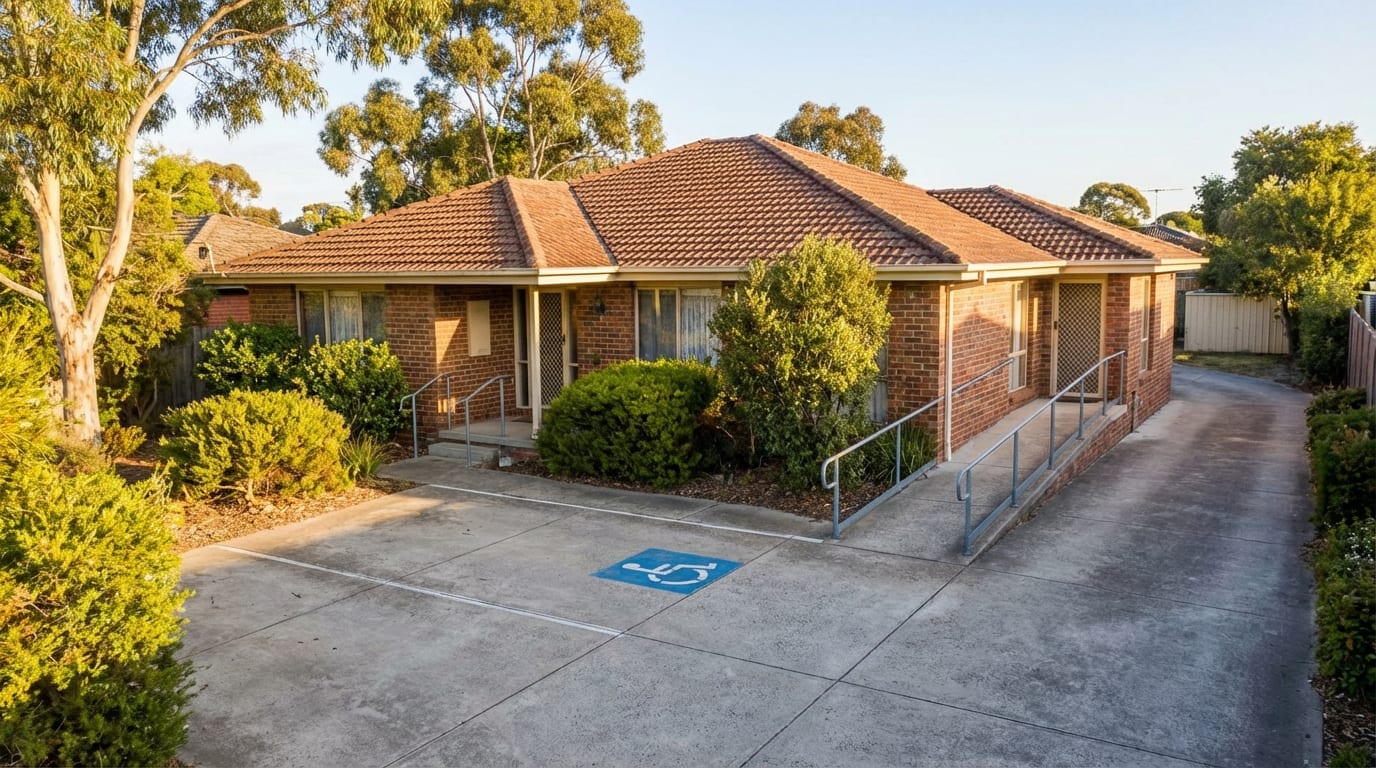
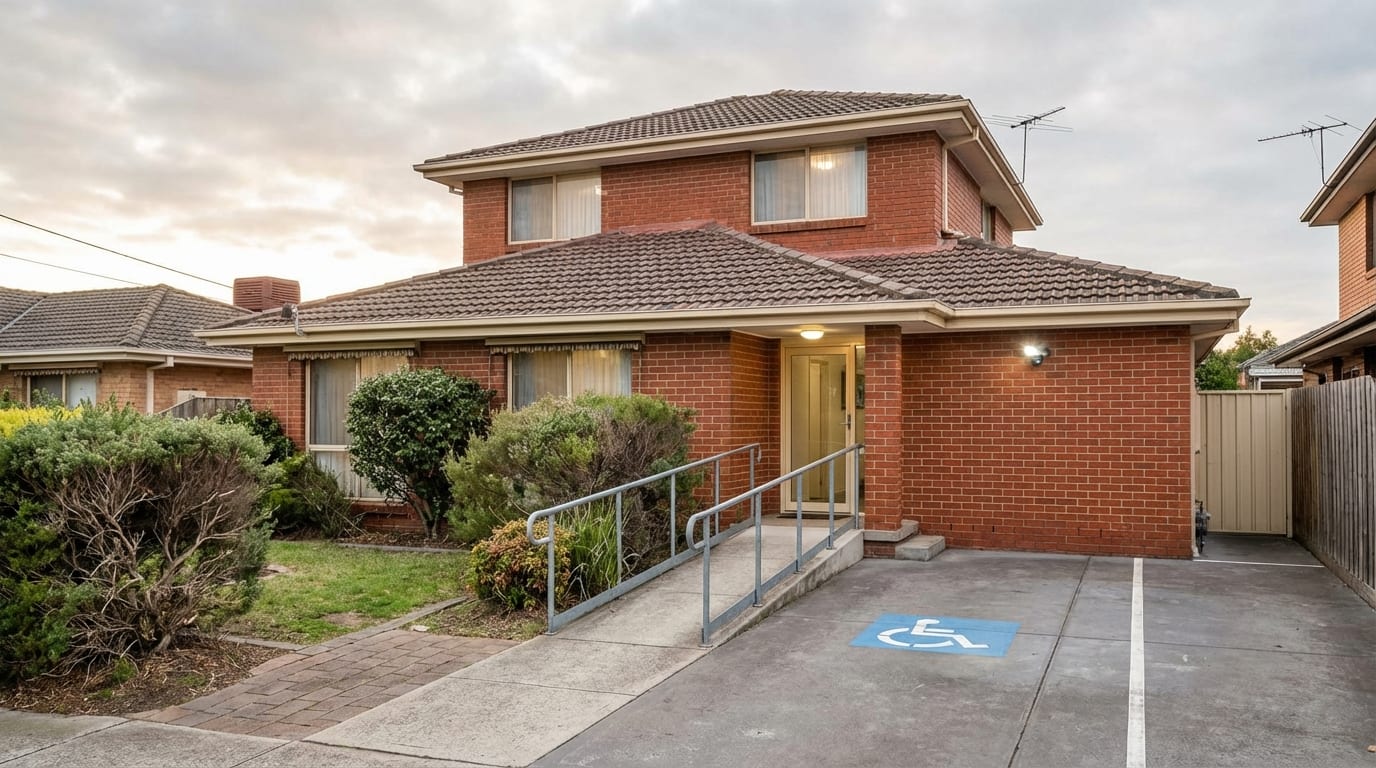
The Rooming House 300 is drawn at nine rooms, each with an ensuite, inside the 300 m² and 12-resident limits that Clause 52.23 of the Victoria Planning Provisions and NCC Class 1b are written around, with an accessible car space and step-free entry in place of a garage. Those choices fix three inputs at design time: the room count (nine), what a room includes (an ensuite, which is priced differently from a shared-bathroom room in the same suburb), and — where the lot is in one of the zones the Clause 52.23 exemption covers and no overlay intervenes — the absence of a planning-permit stage, which shortens the holding period between land settlement and first rent.
Pricing is by written proposal. The proposal states the build contract figure that goes under the line and the scope it covers — slab and frame, nine ensuites, the fire package, the accessible bay, the building permit — so that one verified number can be put into the denominator. It does not state a rent, a yield or a forecast, because those are the reader’s inputs, evidenced from the reader’s suburb and the reader’s manager.
Questions people ask
How do I calculate the yield on a rooming house?
Gross: weekly room rent × rooms × 52, divided by land + build + land transfer duty + holding costs during the build. Net: subtract vacancy, management, land tax, council rates and levy, insurance, maintenance, utilities and licence costs first, then divide by the same denominator. The denominator must include the land; a figure computed on the build cost alone describes a building, not an investment.
Is rent divided by build cost a valid rooming house yield?
No. It leaves the land, the duty and the holding costs out of the denominator, and in Melbourne the land is usually half or more of the total. In the illustrative scenario on this page the all-in denominator ($700,000 land + $700,000 build + $37,070 duty) is 2.05 times the build cost, so a build-only division roughly doubles the apparent result.
How much stamp duty applies to a $700,000 lot bought as an investment in Victoria?
At the State Revenue Office general (non-principal place of residence) rate for dutiable value over $130,000 and up to $960,000, duty is $2,870 plus 6 per cent of the excess over $130,000: $2,870 + $34,200 = $37,070. A foreign purchaser pays an additional 8 per cent of the dutiable value. The SRO duty calculator applies the current table to any contract date.
Does a rooming house pay land tax in Victoria?
Yes, unless an exemption applies. The principal place of residence exemption covers only the home you live in. Land tax is assessed on the site value of all taxable Victorian land you own at midnight on 31 December, aggregated, at the SRO 2024–2033 general rates (nil below $50,000). Section 75 of the Land Tax Act 2005 exempts a registered rooming house used primarily as low-cost accommodation that meets the Commissioner’s guidelines; absentee owners pay a 4 per cent surcharge.
Is there GST on rooming house rent?
The ATO treats rent from residential premises as input taxed — no GST on the rent, no GST credits on costs — but the lease of commercial residential premises such as hostels and boarding houses is subject to GST, and GSTR 2012/6 lists the characteristics (commercial intention, multiple occupancy, central management, services, accommodation supplied by the operator) that decide the category. A rooming house can sit near that line, so confirm the treatment with a registered tax agent before setting rents.
How should I allow for vacancy in a rooming house?
Count vacant room-weeks rather than borrowing a suburb percentage, because each room turns over on its own date. Nine rooms give 468 room-weeks a year; if each room is empty two weeks a year, 18 vacant room-weeks is 3.8 per cent of gross — an example of the method, not a rate. Use a manager’s turnover records for comparable houses, and test the project again with double the vacant weeks.
How often can rent be increased in a rooming house in Victoria?
Consumer Affairs Victoria states that rent for a rooming house resident cannot be increased more than once every 12 months, and that from 25 November 2025 the operator must give at least 90 days’ notice on the prescribed form (Residential Tenancies Act 1997 s 101). Bond is capped at 14 days’ rent for a periodic agreement and 28 days’ rent for a fixed-term agreement.
What did PremiumRea’s dataset show for rooming-house conversions?
In PremiumRea’s open dataset of 345 anonymised transactions (DOI 10.5281/zenodo.20095886), the 48 rooming-house conversions with offer dates from October 2023 to September 2025 recorded a median gross yield of 6.94 per cent on purchase price plus conversion works, with a median works spend of $84,668. It is a historical outcome on conversions of existing houses, before land tax, management, vacancy, insurance and interest — not a forecast and not a new-build figure.
Does vacant residential land tax apply while I am building?
Vacant residential land tax applies across Victoria from 1 January 2025 to residential land not lived in for six months of the previous year, at 1 per cent of capital improved value in the first year, 2 per cent in the second and 3 per cent from the third. The SRO lists land with a residence under construction or renovation in the previous year among its exemptions, tied to the building permit date with a discretion to extend; check the current conditions on the SRO page.
How much cash is needed to start a new rooming house build?
Illustratively, on the film scenario and assuming a lender funded 80 per cent of both land and build — an assumption, not an offer, and each lender assesses it — the cash before the first slab is 20 per cent of a $700,000 lot ($140,000) + duty ($37,070) + 20 per cent of a $700,000 build ($140,000) = $317,070, which the films round to $320,000. Conveyancing, permit and surveyor fees, reports, connections, registration, licence and interest during the build are on top.
References
- 1.State Revenue Office — Land transfer duty, non-principal place of residence (current rates) — checked 19 September 2026
- 2.State Revenue Office — Land transfer (stamp) duty calculator — checked 19 September 2026
- 3.State Revenue Office — Understanding foreign purchaser additional duty (8%) — checked 19 September 2026
- 4.State Revenue Office — Land tax current rates (2024–2033 general and trust rates) — checked 19 September 2026
- 5.State Revenue Office — Understanding land tax (site value, 31 December, aggregation, $50,000 threshold) — checked 19 September 2026
- 6.State Revenue Office — Principal place of residence exemption — checked 19 September 2026
- 7.State Revenue Office — Land tax exemption for rooming houses (criteria and 2026 maximum tariffs) — checked 19 September 2026
- 8.Victoria Government Gazette S414, 19 August 2022 — Land Tax Act 2005: guidelines for rooming house exemption under section 75 — checked 19 September 2026
- 9.State Revenue Office — Understanding the absentee owner surcharge (4% from the 2024 land tax year) — checked 19 September 2026
- 10.State Revenue Office — Understanding vacant residential land tax — checked 19 September 2026
- 11.State Revenue Office — Vacant residential land tax current rates (1% / 2% / 3% of CIV) — checked 19 September 2026
- 12.State Revenue Office — Exemptions from vacant residential land tax (construction / renovation category) — checked 19 September 2026
- 13.State Revenue Office — Emergency services and volunteers fund (current rates) — checked 19 September 2026
- 14.Australian Taxation Office — GST and residential property (input taxed rent; commercial residential premises) — checked 19 September 2026
- 15.Australian Taxation Office — GSTR 2012/6 Goods and services tax: commercial residential premises — checked 19 September 2026
- 16.Consumer Affairs Victoria — Rent changes in rooming houses (RTA 1997 ss 101–102A; 90 days’ notice from 25 November 2025) — checked 19 September 2026
- 17.Consumer Affairs Victoria — Bond amounts and paying a bond (rooming house caps: 14 / 28 days’ rent) — checked 19 September 2026
- 18.Residential Tenancies Act 1997 (Vic) — in force (version 114, 9 September 2026): s 3(1) rooming house definition; s 101 rent increases — checked 19 September 2026
- 19.Land Tax Act 2005 (Vic) — in force (version 086, 1 May 2026): s 75 rooming houses — checked 19 September 2026
- 20.Duties Act 2000 (Vic) — in force (version 141, 24 June 2026) — checked 19 September 2026
- 21.Zenodo — Melbourne Investment Property Portfolio: 345 anonymised buyer’s agent transactions (PremiumRea), v1.0.0, CC-BY 4.0, DOI 10.5281/zenodo.20095886 — checked 19 September 2026
- 22.Homes Victoria / DataVic — Rental Report, quarterly: moving annual rents by suburb (RTBA bond data) — checked 19 September 2026
- 23.SQM Research — Residential vacancy rates by postcode (methodology on page) — checked 19 September 2026
- 24.ASIC Moneysmart — Buying an investment property (ownership costs; do not rely on rent to cover the mortgage) — checked 19 September 2026
- 25.ASIC Moneysmart — Choosing home insurance (exclusions are in the PDS) — checked 19 September 2026