Stage one and stage two: land, then a construction loan drawn in arrears
Almost no lender advances the whole cost of a new rooming house on day one. The land settles first, funded from cash or a loan secured over the land alone. The building is then funded by a construction facility: the lender approves a total figure against a fixed-price building contract but releases money only as each stage is certified complete, paying the builder directly and charging interest only on the amount drawn so far. ASIC Moneysmart describes an interest-only period as one that may be useful for a construction loan, and the reason is plain — nothing produces rent until the occupancy permit issues.
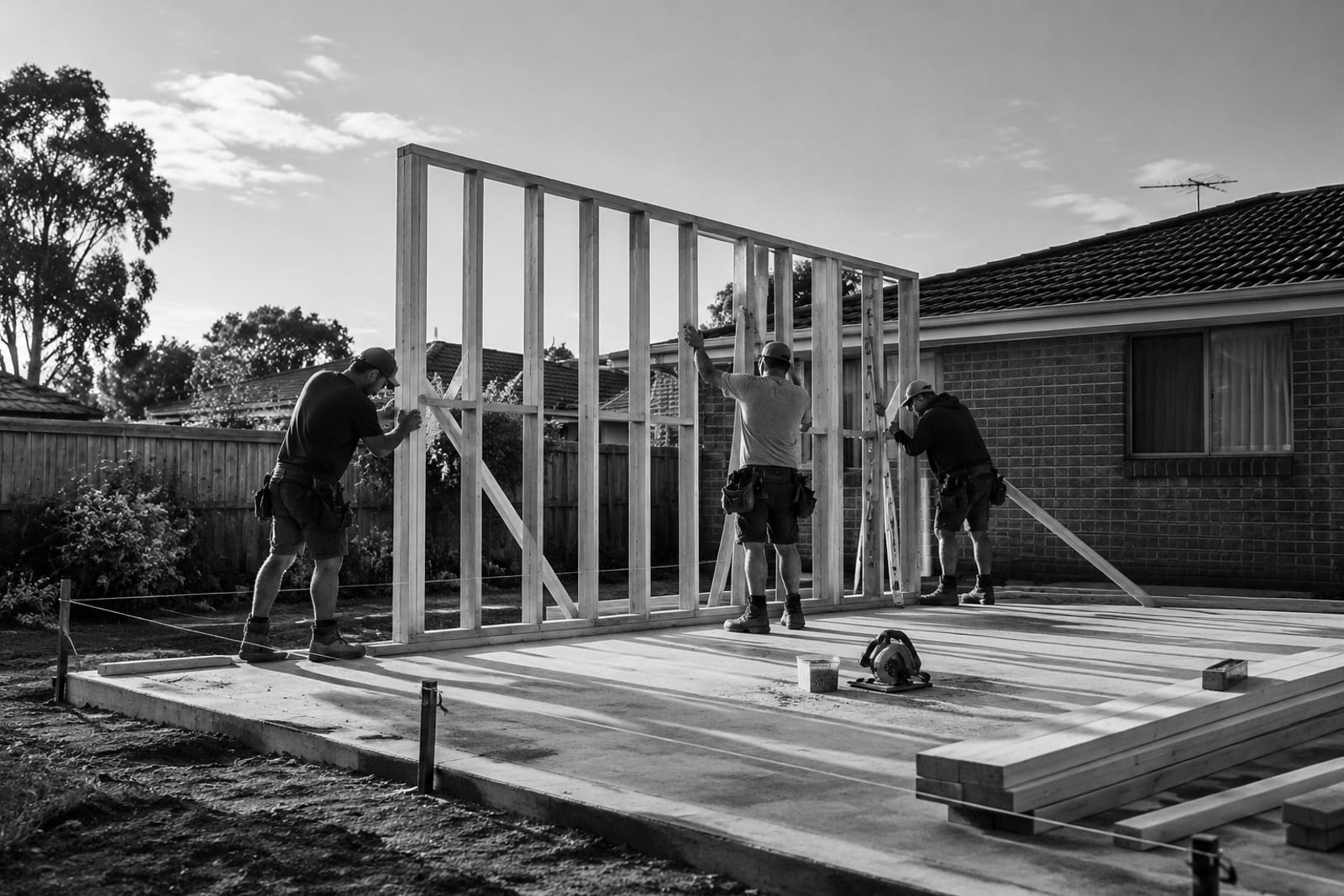
The stages are not the lender’s invention. A contract to build a rooming house is a domestic building contract, because the Domestic Building Contracts Act 1995 (Vic) defines a home as any residential premises, and section 40 caps what a builder may claim at each stage of a major domestic building contract. Lenders align their drawdown schedule to that table, and their inspector — usually a valuer or quantity surveyor — confirms the stage before money moves. Ask any builder for a progress schedule written to the same stages, so the two schedules match line for line.
| Stage (s 40(1) definition) | Cap, build-all-stages contract (s 40(2)) | What the lender’s inspector checks |
|---|---|---|
| Deposit (s 11) | 5% of a contract price of $20,000 or more | Home Warranty (or DBI) certificate issued before the deposit is paid |
| Base — footings poured; for a concrete floor, the floor completed | 10% | Slab and footings against the engineer’s drawings |
| Frame — frame completed and approved by a building surveyor | 15% | Surveyor’s frame inspection on file |
| Lock-up — external cladding and roof fixed, flooring laid, external doors and windows fixed | 35% | Building weather-tight |
| Fixing — internal cladding, architraves, skirting, doors, shelves, baths, basins, sinks, cabinets fitted | 25% | Fit-out in place, including the nine ensuites |
| Completion | Balance (10% in the CAV standard contract) | Occupancy permit (Building Act 1993 s 39) and final valuation |
The deposit, the cooling-off period and the first drawdown
Section 11 caps the deposit at 5 per cent of any contract price of $20,000 or more, payable only before work starts; a builder who takes more faces 100 penalty units and a contract the owner may avoid. Consumer Affairs Victoria adds the practical rule: do not pay the deposit until the builder has given you the insurance certificate for your property, because the scheme may not cover money paid ahead of work. Section 34 then gives the owner five clear business days after receiving the signed contract to withdraw, with the builder keeping only $100 plus approved out-of-pocket costs.
For the lender the deposit is normally the borrower’s own money — the first evidence of the cash contribution — and the first drawdown is the base-stage claim. Contracts signed on or after 1 July 2026 fall under the first-resort Home Warranty scheme run by the Building and Plumbing Commission: it applies to domestic building work over $20,000 on buildings up to three storeys, covers incomplete, defective or non-compliant work up to $400,000, and protects a deposit of up to 5 per cent where work has not started. Contracts signed earlier stay under domestic building insurance, which responds only if the builder dies, disappears or becomes insolvent, capped at $300,000.
“The building does not decide whether it is residential or commercial. The lender’s policy does — so the only honest number is one with “subject to assessment” attached.”
The fork: a residential reading or a commercial reading of the same building
The same nine-room building can be assessed under two credit policies, and the difference decides the cash you need, the loan term and which valuer is instructed. A residential reading treats the property as a dwelling on a single title. The security is a Class 1b building under NCC 2022 Volume One clause A6G2 — a boarding house, guest house, hostel or the like that would ordinarily accommodate not more than 12 people and has a total floor area of not more than 300 m² — and the borrower’s own income, not the rooms, services the debt.
A commercial or specialist reading treats the same building as a licensed business. The operator needs a licence under the Rooming House Operators Act 2016 and council registration under the Public Health and Wellbeing Act 2008; the income arrives through many short agreements; and the resale market for a purpose-built nine-ensuite house is thinner than for a family home. APRA’s practice guide APG 223 expects each regulated lender to decide by its own policy when a facility secured over residential property is, in the guide’s words, more akin to commercial lending than residential lending. That is the honest summary of the fork: a policy line inside each lender, not a rule in any Act.
| Signal | Pulls toward a residential reading | Pulls toward a commercial or specialist reading |
|---|---|---|
| Title and classification | One title, one dwelling-scale building, Class 1b within 300 m² and 12 residents | Multiple titles, or a building outside Class 1b (Class 3) |
| Room count and fit-out | A house that happens to have extra bedrooms | Nine rooms with nine ensuites, keyed doors, a shared kitchen sized for twelve — purpose-built |
| Who runs it | The owner lets rooms through an agent; no business operates from the site | A licensed operator (RHOA 2016 s 7) running a registered business |
| Income used for servicing | Borrower’s salary or other income covers repayments without the rooms | Repayments depend on the room ledger |
| Valuation basis | Direct comparison with house sales in the suburb | Capitalised net income, checked against the few rooming-house sales on record |
| Exit | Saleable as a large house to an owner-occupier or ordinary investor | Saleable mainly to the next rooming-house operator |
What the valuer reads: as-if-complete value, market rent of the whole, scarce comparables
On a construction loan the valuer is instructed before a slab is poured. The report values the land as it stands and the finished building as if complete, working from the fixed-price contract, the stamped plans and the specification, and the lender approves against the lower of cost and that on-completion figure. APG 223 lists desk-top, kerb-side and automated assessments as acceptable in the right context, requires valuer selection to sit with risk staff rather than sales staff, and calls any pressure on a valuer to over-value an indicator of improper behaviour. A rooming house is rarely a desk-top case; expect a full inspection.
Three things in that report decide the number. Rent: a residential valuer assesses the market rent of the property as a whole, as one tenancy, and may set the room-by-room ledger aside entirely, while a specialist valuer capitalises the net income after vacancy, management and outgoings. Comparables: purpose-built nine-bedroom houses sell rarely, so the valuer either compares with ordinary houses, which holds value near that of a large house, or with the few rooming-house sales on record, most of them older converted stock.
Highest and best use is the third. A valuer who concludes the building is worth more as a family home than as a rooming house reports that, and the cost of nine ensuites does not come back dollar for dollar. None of this is a reason not to build; it is the reason the on-completion figure, not the build cost, is the number a lender works from — and why the planning position under Clause 52.23 and the Class 1b classification belong in the valuer’s brief.
- —Ask which rental basis the lender will instruct — market rent as a whole or room income — before you apply, not after the report lands.
- —Give the valuer the building permit, the planning position, the Class 1b classification, and a rent appraisal for the whole building as well as a room schedule.
- —Any shortfall between cost and the on-completion value is funded by you, not by a larger loan; budget for it before the land contract.
Cash required: why “80 per cent finance, subject to lender assessment” is the only honest phrasing
Anyone who tells you a rooming house is financed at a fixed percentage is guessing on the lender’s behalf. The percentage is the output of the fork above, the valuation basis and the serviceability test below, none of which a builder controls. The defensible sentence is conditional: a lender applying its standard residential policy may lend a stated share of the lower of cost and valuation, subject to its own assessment of the security and of you. The term, whether the room income counts, and the conditions all follow from that assessment, and it can change between pre-approval and the on-completion valuation.
The arithmetic is worth doing on the site’s film scenario, which is illustrative and not a forecast for any property: a Melbourne lot at $700,000 plus a $700,000 build is a $1,400,000 project, so a facility assessed at 80 per cent of cost leaves $280,000 to fund from cash before stamp duty on the land, legal and valuation fees, the operator licence and council registration, and interest during construction — and every ten percentage points a lender takes off its assessment adds $140,000 to that cash figure. That is why the cash contribution, not the headline rent, is usually the binding constraint, and why the arithmetic belongs before the land contract, not after it.
Serviceability: the APRA buffer, the floor rate and how room income is counted
For an authorised deposit-taking institution the repayment test is fixed by prudential standard, not by the loan officer. Attachment C to Prudential Standard APS 220 Credit Risk Management requires a serviceability buffer of at least 3.0 percentage points over the loan’s interest rate unless APRA determines otherwise, and APG 223 (June 2025 version) says a prudent lender pairs that buffer with an interest-rate floor so the test still bites when rates are low. Non-bank lenders sit outside APS 220 but inside the responsible-lending provisions of the National Consumer Credit Protection Act 2009 where the loan is consumer credit; a loan to a company for a business purpose sits outside that Act, which is one reason the commercial reading changes the paperwork.
Two inputs are specific to a rooming house. Rent: a lender may take the whole-house market rent, take the room ledger with a larger haircut for vacancy and management, or take none of it until the house has a trading history — each is a policy choice, none is predictable from outside. Outgoings: the State Revenue Office assesses land tax on holdings at midnight on 31 December, with no tax below a total taxable value of $50,000, and for a $700,000 lot that is a real annual cost the lender counts.
The rooming-house land tax exemption rarely rescues a new build. It requires the house to be registered with council under Part 6 of the Public Health and Wellbeing Act 2008, at least 80 per cent occupied by long-term residents in the previous year, and let at no more than 70 per cent of the Commonwealth aged pension for lodging only (105 per cent with full board). A nine-ensuite house let at market rent exceeds that tariff cap, so the land tax stays in the serviceability calculation, alongside insurance, management and a vacancy allowance.
Insurance as a lending condition — and the rooming-house exclusion in ordinary policies
A construction loan carries two insurance conditions. During the build the builder holds the Home Warranty policy (or domestic building insurance for a contract signed before 1 July 2026) together with its own contract-works and public-liability cover, and the lender wants the certificates on file before the first drawdown. From the occupancy permit the owner must hold building insurance for the replacement value with the lender’s interest noted, and the loan conditions usually require it to continue for the life of the debt.
The trap is the use. Many standard home and landlord policies define the insured risk as a house occupied by one household or let under a single residential agreement; a registered rooming house with up to twelve unrelated residents under separate agreements is a different risk class, and a policy issued on the wrong description can fail at claim time. The Insurance Contracts Act 1984 (Cth) makes this the insured’s responsibility: section 21 imposes a duty of disclosure, and for a consumer insurance contract — one obtained wholly or predominantly for personal, domestic or household purposes — section 20B substitutes a duty to take reasonable care not to make a misrepresentation.
A policy over a licensed rooming-house business is likely to sit under the first, stricter duty. Tell the insurer in writing that the building is a Class 1b rooming house, state the resident count and the operator licence, and keep the written acceptance; a lender may ask for exactly that letter as a condition of the final drawdown.
Using a broker: what the best-interests duty gives you and what to ask
A mortgage broker is useful on a rooming house for one reason above others: the fork is a policy line inside each lender, and a broker who places these loans knows which policies read a nine-room Class 1b as a dwelling and which do not. Since 1 January 2021 brokers must act in the consumer’s best interests when recommending a loan and must give priority to the consumer’s interests over their own — Part 3-5A of the National Consumer Credit Protection Act 2009, sections 158LA and 158LB, explained in ASIC Regulatory Guide 273. The duty attaches to consumer credit; a loan to a company for a business purpose is outside it, so ask which regime your structure falls under.
ASIC Moneysmart lists the checks: confirm the broker or their business appears on ASIC’s professional registers as a credit licensee or credit representative; ask how many lenders they can place loans with and whether their commission differs between them; ask them to justify why the recommended loan is in your interest and what a lower-cost alternative would be; and get any fee payable by you in writing before they start. Add three rooming-house questions — which of those lenders count room income, which valuers they instruct on a Class 1b, and whether the pre-approval is conditional on the on-completion valuation. If the broker cannot answer them, the fork has not been resolved.
What the lender asks the builder for — and how a compliant proposal is drawn
The credit file for a construction loan is mostly the builder’s file. Before an unconditional approval the lender wants a fixed-price major domestic building contract in writing, signed by both parties and containing what section 31 of the Domestic Building Contracts Act 1995 requires; the Home Warranty certificate (or DBI certificate) in the owner’s name; the stamped plans and specification; the building permit and the planning position — inside the Clause 52.23 envelope, the surveyor’s confirmation that no planning permit is required, otherwise the permit itself; the builder’s registration with the Building and Plumbing Commission; and a progress schedule that matches the section 40 stages. How to check any builder before you sign covers the registers.
DollarBuild’s Rooming House 300 proposal is written so that this file exists on day one: the plan is drawn inside the 300 m² and 12-resident limits of Class 1b, the contract is a fixed-price major domestic building contract with the section 40 schedule, the Home Warranty certificate is issued before the deposit, and the handover pack holds the occupancy permit, the Class 1b classification and the documents the operator needs for the licence and council registration. Whether you build new or convert, that file is what turns a conditional approval into a drawdown. Pricing is by written proposal; finance is a matter between you and your own broker or lender.
- —Fixed-price major domestic building contract (DBCA 1995 s 31) with a progress schedule at the s 40 stages
- —Home Warranty certificate (contracts from 1 July 2026) or domestic building insurance certificate, issued before the deposit (s 11)
- —Stamped plans, specification and the engineer’s slab design
- —Building permit, and the planning position — Clause 52.23 exemption or a planning permit
- —Builder’s registration on the Building and Plumbing Commission register
- —On completion: occupancy permit (Building Act 1993 s 39), final valuation, building insurance with the lender’s interest noted
Questions people ask
Is a rooming house loan residential or commercial?
Either, and the same building can be read both ways. A lender reading it as residential relies on the single title, the dwelling-scale NCC Class 1b classification (not more than 300 m² and ordinarily not more than 12 people, NCC 2022 clause A6G2) and the borrower’s own income. A lender reading it as commercial relies on the operator licence under the Rooming House Operators Act 2016, the dependence on room income and the thinner resale market. APG 223 leaves that line to each lender’s own policy.
How is a new-build rooming house financed?
In two stages. The land settles first, funded by cash or a land loan. The build is funded by a construction loan drawn in arrears against the stages of a major domestic building contract — section 40 of the Domestic Building Contracts Act 1995 (Vic) caps a build-all-stages contract at 10 per cent base, 15 per cent frame, 35 per cent lock-up and 25 per cent fixing — with interest charged only on the amount drawn, then converted or refinanced once the occupancy permit issues.
What deposit can the builder ask for?
Under section 11 of the Domestic Building Contracts Act 1995 (Vic), no more than 5 per cent of a contract price of $20,000 or more (10 per cent below $20,000), and only before work starts; taking more carries 100 penalty units and lets the owner avoid the contract. Consumer Affairs Victoria advises not to pay the deposit until the builder has given you the Home Warranty or domestic building insurance certificate for your property.
Can I borrow 80 per cent of the cost of a rooming house?
Only a lender can answer that, after its assessment of the security and of you — which is why the honest phrasing is “80 per cent finance, subject to lender assessment”. The percentage is an output of the residential-versus-commercial reading, the valuation basis (whole-house rent or room income) and the serviceability test, and it can move between pre-approval and the on-completion valuation. Budget to fund any gap between cost and valuation from cash.
What is an as-if-complete valuation?
A valuation prepared before construction that reports the value of the land now and of the finished building as if the fixed-price contract, plans and specification were already built. The lender approves the construction loan against the lower of cost and that on-completion figure and releases each progress payment after an inspection. For a rooming house the report also states the rental basis used — market rent of the whole or capitalised room income.
Do lenders count room-by-room rent?
Some do, with a larger allowance for vacancy and management; some take only the market rent of the house as a single tenancy; some take none of it until the house has a trading history. It is a policy choice inside each lender and cannot be read from outside, so ask the broker or lender which basis applies before the application, and give the valuer both a whole-house rent appraisal and a room schedule.
What serviceability buffer applies?
For an APRA-regulated lender, at least 3.0 percentage points above the loan’s interest rate under Attachment C of Prudential Standard APS 220, applied with an interest-rate floor as APG 223 (June 2025 version) describes. Non-bank lenders are not bound by APS 220 but, for consumer loans, by the responsible-lending provisions of the National Consumer Credit Protection Act 2009. Land tax, insurance, management and a vacancy allowance are counted as outgoings.
Does the rooming-house land tax exemption apply to a new build?
Usually not. The State Revenue Office exemption requires the house to be registered under Part 6 of the Public Health and Wellbeing Act 2008, at least 80 per cent occupied by long-term residents and let at no more than 70 per cent of the Commonwealth aged pension for lodging only (105 per cent with full board). A nine-ensuite house let at market rent exceeds that tariff cap, so land tax — assessed on 31 December holdings above $50,000 — stays in your outgoings.
Will a standard landlord policy cover a rooming house?
Often not as written. Many home and landlord policies define the risk as one household or one residential agreement; a registered rooming house with unrelated residents on separate agreements is a different class. Disclose the Class 1b use, the resident count and the operator licence — the Insurance Contracts Act 1984 (Cth) imposes a duty of disclosure (s 21) or, for consumer contracts, a duty to take reasonable care not to misrepresent (s 20B) — and keep the insurer’s written acceptance for the lender.
What documents does the lender need from the builder?
A signed fixed-price major domestic building contract meeting section 31 of the Domestic Building Contracts Act 1995, a progress schedule at the section 40 stages, the Home Warranty (or DBI) certificate in your name, stamped plans and specification, the building permit and the planning position under Clause 52.23, the builder’s Building and Plumbing Commission registration, and at the end the occupancy permit under section 39 of the Building Act 1993 with a final valuation.
References
- 1.Domestic Building Contracts Act 1995 (Vic) — authorised version No. 094, in force 1 July 2026 (ss 3, 11, 34, 40) — checked 19 September 2026
- 2.Domestic Building Contracts Act 1995 (Vic) — in-force page, legislation.vic.gov.au — checked 19 September 2026
- 3.Consumer Affairs Victoria — Deposits and payments for building work (5% / 10% deposit cap; 10 / 15 / 35 / 25 stage payments; certificate before deposit) — checked 19 September 2026
- 4.Consumer Affairs Victoria — Domestic building insurance and insolvency (Home Warranty from 1 July 2026: over $20,000, up to $400,000, 5% deposit protection; DBI $300,000) — checked 19 September 2026
- 5.Consumer Affairs Victoria — Domestic building insurance for builders (works over $16,000; certificate before any money is taken) — checked 19 September 2026
- 6.Consumer Affairs Victoria — New protections for homeowners set to build (23 June 2026) — checked 19 September 2026
- 7.Building Legislation Amendment (Buyer Protections) Act 2025 (Vic), No. 17/2025 — as made — checked 19 September 2026
- 8.APRA — Prudential Practice Guide APG 223 Residential Mortgage Lending (version dated 19 June 2025; buffer of at least 3.0% under APS 220 Attachment C; security valuation) — checked 19 September 2026
- 9.APRA — Prudential Standard APS 220 Credit Risk Management (in force 1 January 2023) — checked 19 September 2026
- 10.ASIC Moneysmart — Using a mortgage broker (best-interests duty, commissions, ASIC registers) — checked 19 September 2026
- 11.ASIC Moneysmart — Interest-only home loans (interest-only period “may be useful for … a construction loan”) — checked 19 September 2026
- 12.ASIC Moneysmart — Glossary: construction loan — checked 19 September 2026
- 13.ASIC — Professional registers search (credit licensees, credit representatives) — checked 19 September 2026
- 14.ASIC — Regulatory Guide 273 Mortgage brokers: Best interests duty (24 June 2020) — checked 19 September 2026
- 15.National Consumer Credit Protection Act 2009 (Cth) — Part 3-5A ss 158LA–158LB (compilation in force 1 July 2026) — checked 19 September 2026
- 16.Insurance Contracts Act 1984 (Cth) — ss 20B, 21 (compilation of 1 March 2024) — checked 19 September 2026
- 17.NCC 2022 Volume One — Part A6 Building classification (A6G2 Class 1b: not more than 12 people, total floor area not more than 300 m²) — checked 19 September 2026
- 18.Consumer Affairs Victoria — Rooming house operators: definitions (four or more people; operator runs the rooming house as a business) — checked 19 September 2026
- 19.Consumer Affairs Victoria — Rooming house operators licensing scheme (RHOA 2016, from 26 April 2017; council registration under the PHW Act 2008 unchanged) — checked 19 September 2026
- 20.State Revenue Office Victoria — Land tax, current rates ($50,000 threshold; holdings at 31 December) — checked 19 September 2026
- 21.State Revenue Office Victoria — Land tax exemption for rooming houses (Part 6 PHW Act registration; 80% long-term residents; 70% / 105% aged-pension tariff caps) — checked 19 September 2026
- 22.Building Act 1993 (Vic) — authorised version No. 152 (s 39 occupancy permit must be obtained) — checked 19 September 2026
- 23.Residential Tenancies Act 1997 (Vic) — s 3(1) rooming house definition (in-force version 114) — checked 19 September 2026