Two instruments, two regulators, one building
Victoria does not keep its rooming house minimum standards in one place. The Public Health and Wellbeing (Prescribed Accommodation) Regulations 2020 sit under the Public Health and Wellbeing Act 2008 and are read by the council’s environmental health officer when the premises are registered and at every renewal. The Residential Tenancies (Rooming House Standards) Regulations 2023 are made under ss 142C and 511 of the Residential Tenancies Act 1997, are enforced by the Director of Consumer Affairs Victoria, and give residents a duty they can act on themselves. A building can satisfy one instrument completely and still fail the other.
The 2023 Standards commenced on 26 February 2023 (reg 3) and revoked the Residential Tenancies (Rooming House Standards) Regulations 2012 outright (reg 4). Anything still quoting the 2012 regulation numbers is describing a repealed instrument. Several standards in the 2023 set were then staged — power outlets tightened on 26 February 2024, light-blocking window coverings landed on 26 February 2025, and regulation 9A, inserted by the Minimum Energy Efficiency and Safety Standards amendment (S.R. 130/2024), carries heating obligations dated 1 December 2025 and 1 December 2030.
The two instruments are wired together on purpose. Section 73(1) of the Public Health and Wellbeing Act 2008 lets a council require alterations or improvements so that the premises comply with that Act, its regulations, or any applicable regulations made under Division 8 of Part 3 of the Residential Tenancies Act 1997 — which is exactly where the 2023 Standards sit. Section 76(2)(ab) then makes non-compliance with those standards a ground to refuse or cancel registration. In practice the council can hold your certificate of registration over a Consumer Affairs instrument, so both belong on the drawings before the building permit, not after handover.
| Instrument | Made under | Read by | What it governs | Maximum penalty |
|---|---|---|---|---|
| Public Health and Wellbeing (Prescribed Accommodation) Regulations 2020 (S.R. 132/2020, v005) | Public Health and Wellbeing Act 2008 | Council environmental health officer, at registration and renewal | Bedroom size and occupancy, sanitary ratio, water, sewage, refuse, cleanliness, maintenance, the register of occupants | 20 penalty units ($4,182) per standard; infringements of 4 or 10 units under reg 24 |
| Residential Tenancies (Rooming House Standards) Regulations 2023 (S.R. 10/2023, v002) | Residential Tenancies Act 1997 ss 142C and 511 | Director of Consumer Affairs Victoria; residents through a duty provision | Locks, power outlets, window coverings, heating, kitchen, dining, laundry, lighting, ventilation, electrical protection, gas and electrical checks, entrances, structure, mould | RTA s 142B — 150 penalty units ($31,365) natural person, 750 ($156,825) body corporate |
| Building Act 1993, Building Regulations 2018 and the NCC (context, not a “minimum standard”) | Building Act 1993 | Relevant building surveyor; municipal building surveyor after handover | Class 1b classification, smoke alarms and evacuation lighting, exits, access for people with a disability, essential safety measures | Varies by regulation — e.g. reg 228 (exits kept clear) 20 penalty units |
The bedroom: 7.5 m², the lock, two outlets, the covering and the heater
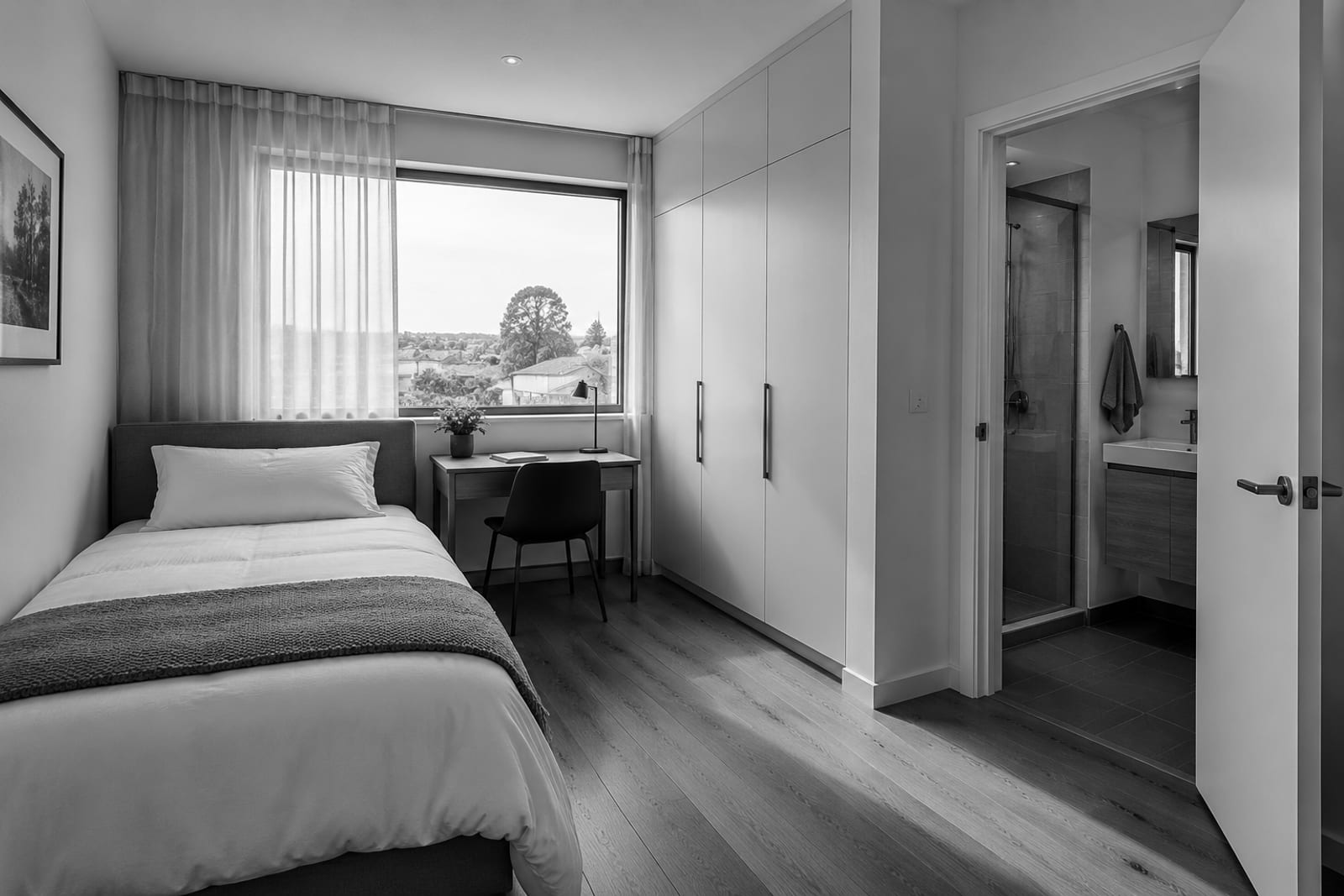
The bedroom is the only room governed by both instruments at once, and the numbers come from the council side. Regulation 11(2) of the Prescribed Accommodation Regulations 2020 prohibits a proprietor from permitting a room with a floor area of less than 7.5 m² to be used as a bedroom. Regulation 11(3) then sets the occupancy for stays of more than 31 days — the case for a rooming house let by the week — at one person for a room under 12 m², and two people for a room of 12 m² or more plus one further person for every 4 m² above 12 m².
Regulation 11(6)(c) decides how that area is measured, and it is the sentence most often missed on a plan: floor area includes the area occupied by any cupboard or other built-in furniture, fixture or fitting, but does not include any area occupied by a bathroom or toilet in, or attached to, the bedroom. An ensuite therefore buys the resident privacy and buys the operator nothing toward the 7.5 m². A 12 m² room with a 3 m² ensuite has to be drawn at 15 m² of total room envelope.
The 2023 Standards then fit out that same room. Every one of the items below is a separate standard with its own regulation number, so a room can fail on one and pass on the rest.
- —Regulation 9A defines a fixed heater as an electric ducted or hydronic system, a non-portable non-ducted air conditioner or heat pump with a 2-star or higher heating rating in the GEMS rating system, or an electric heater not designed or manufactured to be solely portable. A plug-in column heater in the corner does not satisfy the standard.
- —An energy-efficient fixed heater, the 1 December 2030 test, is narrower: a non-ducted air conditioner or heat pump with a 2-star or higher heating rating, or a ducted system with a Heating Seasonal Performance Factor of 3.2 or above.
- —The grounds on which installation is “unreasonable” are listed, not open-ended — installation cost significantly above the average for an equivalent Class 1, 2 or 3 building; owners corporation rules; another Act or local law making the cost prohibitive; an existing gas ducted or hydronic outlet in the room; a warranty replacement of an identical type; or a refused Heritage Act 2017 s 101 permit (reg 9A(3)).
- —A new build has none of those excuses available to it, which is why the heating decision belongs in the electrical design, not in a retrofit budget.
| Instrument | Regulation | Requirement | Where it lands on the plan |
|---|---|---|---|
| Prescribed Accommodation Regs 2020 | reg 11(2) | No room with a floor area under 7.5 m² may be used as a bedroom | Minimum room dimension; dictates the module of the whole building |
| Prescribed Accommodation Regs 2020 | reg 11(3) | Stays over 31 days: under 12 m² = 1 person; 12 m² or more = 2 people, plus 1 per extra 4 m² | Which rooms are single and which are drawn at 12 m² or more for two residents |
| Prescribed Accommodation Regs 2020 | reg 11(6)(c) | Area includes built-in furniture, fixtures and fittings; excludes an ensuite bathroom or toilet | Room envelope must be drawn as habitable area plus the ensuite, not inclusive of it |
| Rooming House Standards Regs 2023 | reg 7 | Entry door fitted with a locking device operated by a key from outside and unlockable from inside without a key; “key” includes a fob or PIN (reg 7(2)) | Door hardware schedule; no double-cylinder deadlock on a bedroom door |
| Rooming House Standards Regs 2023 | reg 8(2) | At least 2 unoccupied power outlets in safe working order available to the resident, additional to any outlet powering operator-supplied appliances, installed to AS/NZS 3000 by a licensed electrician | Electrical layout: count outlets after the fridge, heater or TV the operator supplies |
| Rooming House Standards Regs 2023 | reg 9 | Window covering the resident can open and close that affords reasonable privacy; from 26 February 2025 it must also reasonably block light and be of a domestic kind | Window schedule: blockout blinds, not a sheer curtain |
| Rooming House Standards Regs 2023 | reg 9A(2) | From 1 December 2025: a fixed heater in good working order installed in, or with an outlet in, each resident’s room, unless unreasonable under reg 9A(3) | One heating unit per room, plus the circuit and the external condenser space |
| Rooming House Standards Regs 2023 | reg 9A(4) | From 1 December 2030: an energy-efficient fixed heater, or a fixed heater where that is unreasonable (regs 9A(5) and (6)) | Specify a compliant heat pump now and the 2030 change is already met |
| Rooming House Standards Regs 2023 | reg 19(2) | Habitable rooms must have natural light (including borrowed light) during daylight hours and artificial light at other times, at an illuminance appropriate to the room’s use | Window area and the lighting layout for every bedroom |
| Rooming House Standards Regs 2023 | reg 16 | An evacuation diagram prepared under section 3.5 and Appendix E of AS 3745, prominently displayed in each resident’s room | A fixed display position inside every room door |
| Residential Tenancies Act 1997 | s 124(2) | A one-page statement of the resident’s rights and duties in a form approved by the Director, and a copy of the house rules, displayed prominently in each resident’s room (25 penalty units) | The same display position as the evacuation diagram |
“Two instruments read the same building: the council reads the Prescribed Accommodation Regulations at registration, Consumer Affairs Victoria reads the 2023 Standards for the life of the building — and a plan that satisfies only one of them is not finished.”
Bathroom and toilet: one per ten, and the bolt on the door
The sanitary ratio is a council standard, not a Consumer Affairs one. Regulation 20 of the Prescribed Accommodation Regulations 2020 requires the proprietor to provide at least one toilet, one bath or shower and one wash basin for every 10 people, or fraction of that number, occupying the accommodation. The words “or fraction” do the work: 10 residents need one of each, 11 need two, and a building designed for the Clause 52.23 ceiling of 12 residents needs two of each as its legal floor. Nothing in the 2023 Standards repeats this ratio — regulation 11 there is about the door and the shower head.
Water is also a council standard. Regulation 15(1) requires a continuous and adequate supply of water to all toilet, bathing, kitchen, laundry and drinking water facilities, and reg 15(2) requires a continuous and adequate supply of hot water to all bathing, laundry and kitchen facilities. For a nine-ensuite building that is a sizing question for the hot water plant at design stage, because “continuous and adequate” is judged in use, at 7 am, not on the specification sheet.
| Instrument | Regulation | Requirement | Where it lands on the plan |
|---|---|---|---|
| Prescribed Accommodation Regs 2020 | reg 20 | At least 1 toilet, 1 bath or shower and 1 wash basin per 10 people or fraction of that number | The minimum fixture count; 12 residents = 2 of each |
| Prescribed Accommodation Regs 2020 | reg 15(1) | Continuous and adequate water supply to all toilet, bathing, kitchen, laundry and drinking water facilities | Hydraulic design and the incoming main |
| Prescribed Accommodation Regs 2020 | reg 15(2) | Continuous and adequate hot water to all bathing, laundry and kitchen facilities | Hot water plant sizing and recirculation |
| Prescribed Accommodation Regs 2020 | reg 14(1) | Each bedroom and any toilet or bathroom attached to it cleaned after it is vacated and before re-use by another occupier | An operating obligation, but it argues for surfaces that can be cleaned between residents |
| Prescribed Accommodation Regs 2020 | reg 17 | All sewage and waste water discharged to a reticulated sewerage system, or to a system authorised under the Environment Protection Act 2017 | Sewer connection, or an authorised on-site system on an unsewered lot |
| Rooming House Standards Regs 2023 | reg 11(2) | Door to a shared toilet or bathroom fitted with a bolt or catch that can be securely latched from the inside without a key, installed by a suitably qualified person; a cabin hook does not count (reg 11(3)) | Door hardware schedule for every shared sanitary door |
| Rooming House Standards Regs 2023 | reg 11(5) | Where a shower is present, a shower head rated 3 stars or higher under the WELS scheme; 1 or 2 stars only where a 3-star head cannot be installed or will not operate effectively because of the age, nature or structure of the plumbing | Tapware schedule — a new build has no excuse for a lower rating |
| Rooming House Standards Regs 2023 | reg 18(2)(a) | In a Class 1b building, each habitable room, bathroom, shower room, toilet and laundry ventilated to Performance Requirement H4P5 or the Deemed-to-Satisfy provision H4D7(2) of BCA Volume Two | Mechanical extraction and its duct runs, signed off by the building surveyor |
Kitchen, dining, laundry and waste: the per-12 and per-4 ratios
Regulation 12 of the 2023 Standards is written as a choice — each facility either in every resident’s room or in a common area — and the ratios only apply to the common-area branch. An oven in good working order is required for every 12 or fewer residents who do not have one in their room; a cooktop in a common area must have 4 burners, again for every 12 or fewer such residents; and both counts are taken on the maximum number of residents the rooming house can accommodate, not on how many happen to be living there this week.
Refrigeration is the ratio that surprises people. Under reg 12(2)(c)(ii), common-area refrigerators must provide a minimum gross capacity of 400 litres for every 4 or fewer residents who are not given a fridge in their room, plus an additional 28.5 litres for each additional such resident. The regulation gives its own example: seven residents with no in-room fridge require a combined minimum gross capacity of 485.5 litres. Run the same formula at 12 residents and the shared kitchen needs 628 litres — two large refrigerators, with the power and the floor space allowed for them at design stage rather than found later.
Dining is regulation 13: a number of chairs equal to the maximum number of residents that can be accommodated in a resident’s room in the rooming house, and one or more dining tables that can comfortably accommodate that number of chairs. A benchtop counts as a dining table if it is big enough, but not if it is wholly or partly the food preparation area required by reg 12 — so the island bench cannot be both the prep zone and the dining table.
| Instrument | Regulation | Requirement | Where it lands on the plan |
|---|---|---|---|
| Rooming House Standards Regs 2023 | reg 12(2)(b) | An area intended to be used solely for food preparation, in each resident’s room or in a common area | A dedicated prep bench that is not counted as anything else |
| Rooming House Standards Regs 2023 | reg 12(1)(b) | A sink, in each resident’s room or in a common area | Kitchen hydraulics |
| Rooming House Standards Regs 2023 | reg 12(1)(c) | An oven in good working order, in each room or one in a common area for every 12 or fewer residents without one in their room | One oven covers a 12-resident building; a 13th resident forces a second |
| Rooming House Standards Regs 2023 | reg 12(1)(d) | A cooktop in good working order — with 4 burners where it is in a common area — for every 12 or fewer such residents | A 4-burner minimum, not a 2-burner domestic unit |
| Rooming House Standards Regs 2023 | reg 12(2)(c) | Refrigeration: 80 L minimum gross capacity in each resident’s room, or in a common area 400 L per 4 or fewer residents plus 28.5 L per additional resident | 628 L combined for 12 residents — two units, two power points, dedicated recess |
| Rooming House Standards Regs 2023 | reg 12(1)(f) | At least one cupboard per resident with at least 0.10 m³ of storage, lockable where it is in a common area | Twelve lockable food cupboards in the shared kitchen joinery |
| Rooming House Standards Regs 2023 | reg 13 | Chairs equal to the maximum number of residents accommodated in a resident’s room, and tables that comfortably accommodate them; a prep benchtop cannot double as the table (reg 13(2)) | A dining zone separate from the kitchen bench |
| Rooming House Standards Regs 2023 | reg 14(2) | Per 12 or fewer residents, in good working order: a laundry trough or basin with continuous hot and cold water, a designated washing-machine space immediately beside it with hot and cold outlets, a clothes line or drying facility, and a washing machine | A laundry room with the machine supplied, plus an external drying area |
| Prescribed Accommodation Regs 2020 | reg 18 | Sufficient vermin-proof receptacles for the collection and storage of all rubbish, regularly cleaned | A screened, hosed bin store sized for 12 residents |
| Prescribed Accommodation Regs 2020 | reg 19 | All refuse regularly removed by a council or private collection service | Bin presentation point and truck access |
| Prescribed Accommodation Regs 2020 | reg 13 | All bedrooms, toilets, bathrooms, laundries, kitchens, living rooms and common areas maintained in good working order, in a clean, sanitary and hygienic condition, and in a good state of repair | Material and finish selection — everything here is inspected annually |
Common living areas, corridors, exits and the outside
Away from the bedrooms the 2023 Standards switch from amenity to safety and security. Every power outlet and lighting circuit in the building must be connected to a switchboard-type circuit breaker complying with AS/NZS 3000 and a switchboard-type residual current device complying with AS/NZS 3190, AS/NZS 61008.1 or AS/NZS 61009.1 (reg 17) — a whole-of-building requirement that the electrical certificate of compliance at handover should already evidence.
Entrances are regulation 25. Each entrance needs a locking device operated by a key from outside and unlockable from inside without a key, and the main entrance needs a window, peephole or intercom system plus external artificial lighting during non-daylight hours at a level that allows safe access and lets a resident screen visitors. Openable external windows need to be securely fixable in the open or closed position without a key and, since 26 February 2024, to carry a functioning latch that secures the window against external entry (reg 24(2)).
Two standards that read like maintenance are really design outcomes: the building must be structurally sound and weatherproof (reg 26) and free from mould and damp caused by or related to the building structure (reg 27). Both are absolute, both survive handover, and both are the reason a nine-ensuite building needs its wet-area waterproofing and mechanical extraction designed rather than assumed.
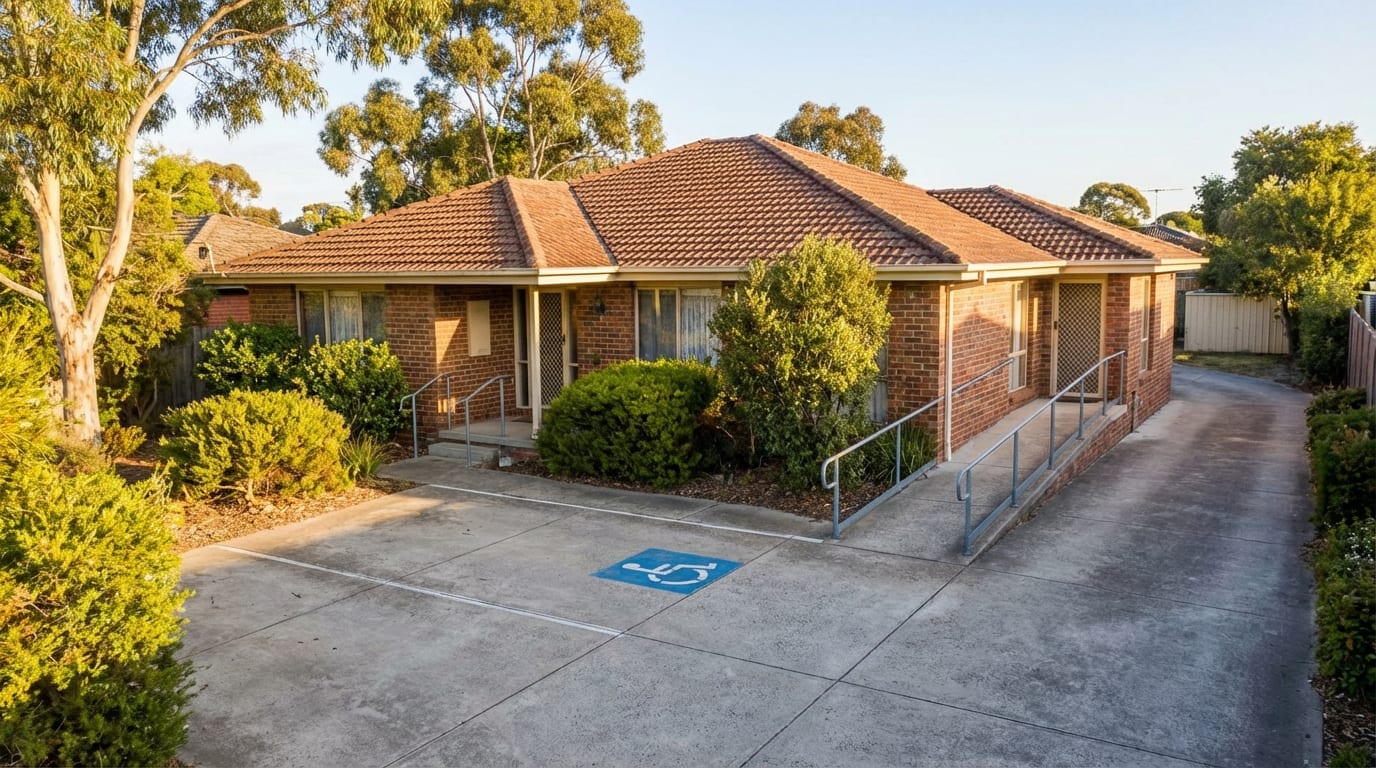
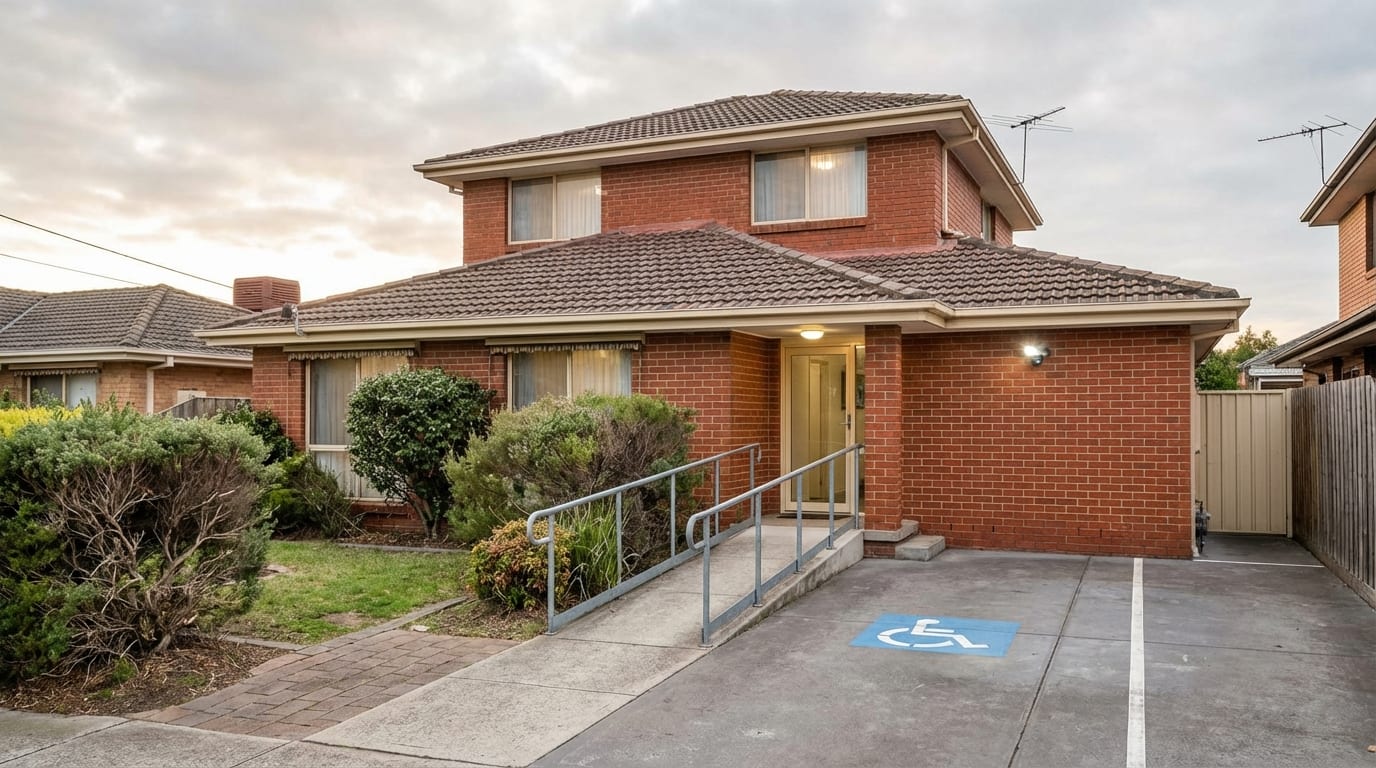
Neither minimum-standards instrument says anything about a car space, a ramp or a smoke alarm. Those come from the building side — access for people with a disability under NCC 2022 Volume One Part D4 and Building Regulations 2018 reg 236, and interconnected smoke alarms and evacuation lighting under NCC Volume Two Part H3 and Housing Provisions Part 9.5, which are set out in the Class 1b fire-safety article. Building Regulations 2018 reg 228 adds the operating duty that ties them together: the occupier must keep exits and paths of travel to a road or open space readily accessible, functional and clear of obstructions, on penalty of 20 penalty units.
| Instrument | Regulation | Requirement | Where it lands on the plan |
|---|---|---|---|
| Rooming House Standards Regs 2023 | reg 22 | From 26 February 2025, windows in a habitable room likely to be used as a living area (other than a resident’s room) fitted with an internal covering that reasonably blocks light and is of a domestic kind | Blinds to the shared lounge and dining windows |
| Rooming House Standards Regs 2023 | reg 19(1) | Internal rooms, corridors and hallways have access to natural or artificial light at an illuminance appropriate to their function | Corridor lighting circuit and its switching |
| Rooming House Standards Regs 2023 | reg 16(b) | The AS 3745 evacuation diagram prominently displayed in all common areas as well as in each room | Fixed display positions in the corridor and the common room |
| Rooming House Standards Regs 2023 | reg 25(1)(a) | Each entrance fitted with a locking device operated by a key from outside and unlockable from inside without a key | Entry door hardware; no key-operated deadlock on the inside face |
| Rooming House Standards Regs 2023 | reg 25(1)(b) | Main entrance has a window, peephole or intercom, and external artificial lighting during non-daylight hours sufficient for safe access and to screen visitors | Intercom or vision panel plus a photocell-controlled entry light |
| Rooming House Standards Regs 2023 | reg 24(2) | Each openable external window securely fixable open or closed without a key, with a functioning latch securing it against external entry | Window hardware schedule across the whole building |
| Rooming House Standards Regs 2023 | reg 23 | Corded internal window coverings installed from 1 January 2015 comply with the Commonwealth corded window coverings safety standard; older ones need a cord guide or cleat at 1600 mm or higher so no loop of 220 mm or more forms below that height | Blind selection and its installation detail |
| Rooming House Standards Regs 2023 | reg 17 | All power outlets and lighting circuits connected to an AS/NZS 3000 switchboard circuit breaker and a switchboard-type RCD to AS/NZS 3190, 61008.1 or 61009.1 | Switchboard schedule; evidenced by the certificate of electrical safety |
| Rooming House Standards Regs 2023 | regs 26 and 27 | Structurally sound and weatherproof; free from mould and damp caused by or related to the building structure | Waterproofing, ventilation and the external envelope |
| Building Regulations 2018 | reg 228 | The occupier must keep exits and paths of travel to a road or open space readily accessible, functional and clear of obstructions (20 penalty units) | Corridor widths and door swings that stay clear once furniture arrives |
The checks, records and notices that keep running after handover
Four of the 2023 Standards are periodic rather than physical, and they start the day the first resident moves in. A gas safety check of all gas installations and fittings must be conducted every 2 years by a licensed or registered gasfitter, and if no check has been done in the previous 2 years at the time a resident occupies the rooming house, one must be completed as soon as practicable (reg 20). Regulation 21 imposes the same 2-year cycle for an electrical safety check by a suitably licensed or qualified electrician, covering all electrical installations, appliances and fittings provided by the operator.
The records are prescribed too. A gas safety check record must name the gasfitter, give their licence or registration number, give the date of the check and the results including any servicing or repairs required and the action taken; it must be kept until the record of the next check is created; and within 7 days of a written request from a resident, the operator must give that resident a copy (reg 28). Regulation 29 prescribes the equivalent record for the electrical check and reg 30 governs production of the records. These are duties under Residential Tenancies Act 1997 s 142BA, which carries 150 penalty units for an individual and 750 for a company.
One honest gap for a new building: the regulations do not say whether the compliance certificates issued at completion start the 2-year clock for regs 20 and 21, or whether a separate safety check is needed before the first resident. Ask the building surveyor and Consumer Affairs Victoria rather than assuming the certificates cover it — the cost of an early check is trivial next to the penalty.
| Obligation | Instrument and regulation | Frequency or trigger |
|---|---|---|
| Gas safety check of all gas installations and fittings by a licensed or registered gasfitter | Rooming House Standards Regs 2023 reg 20 | Every 2 years; as soon as practicable if none in the previous 2 years when a resident occupies |
| Electrical safety check of all installations, appliances and fittings provided by the operator | Rooming House Standards Regs 2023 reg 21 | At least every 2 years, on the same trigger |
| Records of both checks, and production of a copy to a resident within 7 days of a written request | Rooming House Standards Regs 2023 regs 28–30; RTA s 142BA | Gas record kept until the next check is recorded |
| Register of occupants — names, addresses, dates of arrival and departure; the information protected as a condition of registration | Prescribed Accommodation Regs 2020 regs 21 and 23 | Kept for at least 12 months after the last entry |
| Two copies of a condition report in the prescribed form, given before the resident enters occupation; the resident returns one within 5 business days | RTA s 97 (25 penalty units) | Every new resident, every room |
| One-page statement of rights and duties and a copy of the house rules — given to the resident and displayed prominently in each room | RTA s 124 (25 penalty units) | On agreement, then permanently displayed |
| Copy of the rooming house operator licence displayed conspicuously inside the front entrance | Rooming House Operators Act 2016 s 39 (60 penalty units) | Permanent |
| Current occupancy permit displayed and available for inspection | Building Regulations 2018 regs 197 and 199 (10 penalty units each) | Permanent, for a Class 1b built on or after 1 July 1994 |
| Annual essential safety measures report, with maintenance records available at the building | Building Regulations 2018 regs 223–225 | Within 28 days before each anniversary of the occupancy permit |
What the council inspects at registration — and what it can refuse
A rooming house is prescribed accommodation (Prescribed Accommodation Regulations 2020 reg 6(f)), so s 67 of the Public Health and Wellbeing Act 2008 requires the proprietor to register it with the council before it operates — 60 penalty units ($12,546) for a natural person and 300 ($62,730) for a body corporate. The prescribed particulars under reg 8 include a plan of the premises drawn to a scale of not less than 1:100 showing the proposed use of each room, which is how the room areas, the fixture count and the occupancy per room reach the environmental health officer’s desk in the first place.
Before deciding, the council may require information, inspect the premises, and require alterations or improvements so the premises comply with the Act, its regulations or the rooming house standards made under the Residential Tenancies Act 1997 (s 73(1)); it may also register subject to a condition that work is completed within a stated period (s 73(2)). Registration runs for a period the council determines, not more than 3 years, stated on the certificate (s 74(1)(d)) — many councils run calendar-year registrations renewed by 31 December. The step-by-step sequence, the fees and the operator licence that sits alongside it are in registering and licensing a new rooming house.
- —Room areas and the maximum occupancy of each room against reg 11 — councils such as Knox ask for each bedroom’s dimensions in metres and the number of people per room on the application form.
- —The count of toilets, baths or showers and wash basins against reg 20, marked on the 1:100 plan.
- —Water and hot water to every facility (reg 15), sewage and waste water disposal (reg 17), and the refuse arrangements (regs 18 and 19).
- —Maintenance and cleanliness of every room, sanitary facility, laundry, kitchen, living room and common area (regs 13 and 14).
- —The register of occupants and the steps taken to protect the information in it (regs 21 and 23).
- —Advertising that does not claim registration for a class of accommodation other than the one on the certificate (reg 22).
- —Proof of the occupancy permit — councils including Darebin and Knox will not register premises without it — and, in most municipalities, the operator licence.
- —Grounds to refuse or cancel: non-compliance with the Act or regulations, breach of a registration condition, risk to health, and — under s 76(2)(ab) — non-compliance with the rooming house standards themselves.
What a resident can enforce: breach of duty, RDRV and VCAT
The 2023 Standards are not only a regulator’s checklist. Section 120A of the Residential Tenancies Act 1997 makes it the operator’s duty to ensure that a room, a facility or service, and a common area provided to a resident each comply with any applicable rooming house standard. Because that is a duty provision, a resident may serve a breach of duty notice under s 208, specifying the breach, requiring it to be remedied within the required time and stating that a similar breach must not recur. If the notice is not complied with, the resident can apply to VCAT for a compensation or compliance order under s 209.
Repairs run on a separate track. Urgent repairs are dealt with under ss 129 and 130, and for non-urgent repairs the resident may ask the Director of Consumer Affairs Victoria to investigate (s 131) before applying to the Tribunal (s 132); the Director may also investigate a rooming house without any resident application (s 131A). Rental Dispute Resolution Victoria now sits in front of VCAT as a free conciliation service for rooming house disputes about rent, bond, repairs and notices, and either party can still go to the Tribunal.
Behind both sits the offence. Section 142B makes it unlawful for an operator to provide a room, a facility or service, or access to a common area that does not comply with the prescribed standards — 150 penalty units ($31,365) for a natural person and 750 ($156,825) for a body corporate at the 2026-27 penalty unit of $209.10. Consumer Affairs Victoria inspectors, council environmental health officers, building surveyors and the fire services all inspect rooming houses, and a conviction under the rooming house provisions is itself a licence disqualification criterion for five years under Rooming House Operators Act 2016 s 17(1)(f).
- —Residents have a right of 24-hour access to their own room and to the toilet and bathroom facilities (RTA s 121) — a standard no amount of house rules can qualify.
- —Exemptions from a standard are possible but rare: the Director may grant one under regs 31 to 35 of the 2023 Standards where the nature, age or structure of the premises prevents compliance or another legal obligation conflicts, and Consumer Affairs Victoria states that no exemptions have been granted. Design for compliance, not for an exemption.
- —From 25 November 2025, premises must meet the applicable minimum standards at the time they are advertised or offered for rent, and smoke alarms must be correctly installed and tested annually — a Housing Statement reform that applies across rental types.
- —The operator, not the builder, carries every one of these duties. What the builder hands over is a building in which each of them can be met, plus the occupancy permit, the certificates and the essential safety measures schedule that prove it.
How the Rooming House 300 is drawn to the two instruments
The Rooming House 300 is a nine-room building with an ensuite to every room, drawn inside the 300 m² and 12-resident envelope that both NCC Class 1b and Clause 52.23 use. Against reg 20 of the Prescribed Accommodation Regulations, a 12-resident building has a legal floor of two toilets, two baths or showers and two wash basins. Nine ensuites provide nine of each. That is a design decision about privacy, queueing and letting rooms individually, not a compliance requirement — the ratio is met more than four times over, and stating it that way is the honest version.
The ensuites make regulation 11(6)(c) load-bearing in the other direction. Because the area of a bathroom or toilet in or attached to a bedroom is excluded from the floor area, each room is drawn so that the habitable area alone clears 7.5 m², and rooms intended for two residents clear 12 m² before the ensuite is added. Get that wrong and the room is legal as a one-person room and unlawful as a two-person room, which is discovered at the council inspection rather than on site.
Cooking stays in a single shared kitchen, sized to regulation 12 at the building’s maximum of 12 residents: the food preparation area, the sink, the oven, the 4-burner cooktop, combined refrigeration of at least 628 litres, and a lockable cupboard of at least 0.10 m³ for every resident, with a dining table and chairs under reg 13 that are not the prep bench. The laundry carries one trough, one machine space, one washing machine and a drying facility for the same 12 (reg 14(2)). Keeping cooking out of the rooms is also what keeps the building a rooming house rather than self-contained accommodation — the planning reason for that is in the Clause 52.23 article, and the whole-of-building view is in what a Victorian rooming house must have.
| Standard | Legal minimum at 12 residents | How the Rooming House 300 is drawn |
|---|---|---|
| Toilets, baths or showers, wash basins (PA reg 20) | 2 of each | Nine ensuites — one of each per room |
| Bedroom floor area (PA reg 11(2), 11(6)(c)) | 7.5 m² excluding the ensuite | Habitable area clears 7.5 m² with the ensuite drawn outside that figure |
| Two-resident rooms (PA reg 11(3)) | 12 m² excluding the ensuite | Only rooms drawn at 12 m² or more of habitable area are nominated for two residents |
| Oven and cooktop (RHS reg 12(1)(c), (d)) | 1 oven and 1 four-burner cooktop | One shared kitchen with a 4-burner cooktop and oven, sized for the maximum occupancy |
| Common-area refrigeration (RHS reg 12(2)(c)) | 628 L combined | Recess, ventilation and power provided for two large refrigerators |
| Food cupboards (RHS reg 12(1)(f)) | 12 lockable cupboards of 0.10 m³ or more | Lockable cupboard per resident in the shared kitchen joinery |
| Laundry (RHS reg 14(2)) | 1 trough, 1 machine space, 1 washing machine, 1 drying facility | A dedicated laundry with the machine supplied and an external line |
| Heating (RHS reg 9A(2)) | A fixed heater in every resident’s room from 1 December 2025 | A fixed heater specified per room, with the circuit designed in |
Questions people ask
What are the minimum standards for a rooming house in Victoria?
They sit in two instruments. The Public Health and Wellbeing (Prescribed Accommodation) Regulations 2020 cover bedroom size and occupancy, the sanitary ratio, water, sewage, refuse, cleanliness, maintenance and the register of occupants, and are enforced by the council. The Residential Tenancies (Rooming House Standards) Regulations 2023 cover locks, power outlets, window coverings, heating, kitchen, dining, laundry, lighting, ventilation, electrical protection, entrances, structure, mould and the two-yearly safety checks, and are enforced by Consumer Affairs Victoria.
Are the 2012 rooming house standards still in force?
No. Regulation 4 of the Residential Tenancies (Rooming House Standards) Regulations 2023 revoked the 2012 Regulations, and the 2023 Regulations commenced on 26 February 2023 under reg 3. Any checklist that still cites 2012 regulation numbers is describing a repealed instrument. Several 2023 standards were staged afterwards — power outlets from 26 February 2024, light-blocking window coverings from 26 February 2025, and heating under reg 9A from 1 December 2025.
How small can a rooming house bedroom be in Victoria?
Regulation 11(2) of the Public Health and Wellbeing (Prescribed Accommodation) Regulations 2020 prohibits a proprietor from permitting a room with a floor area of less than 7.5 m² to be used as a bedroom, with a penalty of 20 penalty units. That is a floor, not a target: the number of people who may occupy the room is then set separately by reg 11(3) according to the room’s area and the length of stay.
Does an ensuite count toward the 7.5 m² bedroom minimum?
No. Regulation 11(6)(c) of the Prescribed Accommodation Regulations 2020 says the floor area includes the area occupied by any cupboard or other built-in furniture, fixture or fitting, but does not include any area occupied by a bathroom or toilet in, or attached to, the bedroom. Built-in wardrobes count in your favour; the ensuite does not. A 12 m² two-person room with a 3 m² ensuite has to be drawn at about 15 m² overall.
How many people can sleep in one rooming house room?
Over 31 days, regulation 11(3) of the Prescribed Accommodation Regulations 2020 allows one person in a bedroom under 12 m², and two in a bedroom of 12 m² or more plus one more for every 4 m² above 12 m². For stays of 31 days or less, reg 11(4) allows two under 10 m² and three at 10 m² or more plus one per additional 2 m². One child under 3 is not counted; two count as one person (reg 11(6)).
How many toilets and showers does a Victorian rooming house need?
Regulation 20 of the Public Health and Wellbeing (Prescribed Accommodation) Regulations 2020 requires at least one toilet, one bath or shower and one wash basin for every 10 people, or fraction of that number, occupying the accommodation. The fraction matters: 10 residents need one of each, 11 need two, and a building designed for 12 residents needs two of each as its legal minimum. This ratio appears only in that regulation, not in the 2023 Standards.
Does every rooming house room need its own bathroom?
No. Neither instrument requires an ensuite. The Prescribed Accommodation Regulations 2020 set only a ratio — one toilet, one bath or shower and one wash basin per 10 people or fraction (reg 20) — so shared facilities are lawful. Ensuites are a design choice about privacy and letting rooms individually. Where facilities are shared, the door needs a bolt or catch that latches from the inside without a key (Rooming House Standards Regulations 2023 reg 11(2)).
What kitchen facilities must a rooming house provide?
Under regulation 12 of the Rooming House Standards Regulations 2023: an area used solely for food preparation, a sink, an oven in good working order, a cooktop — with 4 burners where it is in a common area — refrigeration, and at least one cupboard per resident with 0.10 m³ of storage, lockable if it is in a common area. The oven and cooktop ratios are per 12 or fewer residents who do not have those facilities in their room, counted on the maximum occupancy.
How big must the shared fridge be in a rooming house?
Regulation 12(2)(c)(ii) of the Rooming House Standards Regulations 2023 requires common-area refrigerators with a combined minimum gross capacity of 400 litres for every 4 or fewer residents not given a fridge in their room, plus 28.5 litres for each additional such resident. The regulation’s own example is 7 residents needing 485.5 litres. At 12 residents the requirement is 628 litres. An in-room refrigerator, if provided, must be at least 80 litres.
Does a rooming house have to provide a washing machine?
Yes, since 26 February 2024. Regulation 14(2) of the Rooming House Standards Regulations 2023 requires, for every 12 or fewer residents and all in good working order, a laundry trough or basin plumbed to a continuous and adequate supply of hot and cold water, a designated space immediately next to it with hot and cold outlets suitable for a washing machine, a clothes line or other drying facility, and a washing machine.
What lock must be fitted to a resident’s bedroom door?
Regulation 7 of the Rooming House Standards Regulations 2023 requires the entry door of a resident’s room to have a locking device that is operated by a key from the outside and can be unlocked from the inside without a key. Regulation 7(2) says “key” includes an electronic fob and a PIN code, so electronic hardware is permitted provided the inside face opens without one. Double-cylinder deadlocks on a bedroom door do not comply.
How many power outlets must a rooming house room have?
At least two. Since 26 February 2024, regulation 8(2) of the Rooming House Standards Regulations 2023 requires at least 2 unoccupied electrical power outlets in safe working order that are available for use by the resident and are in addition to any other outlets already used to power amenities the operator supplies — so a fridge, heater or television provided by the operator cannot consume one of the two. Outlets must be installed by a suitably licensed electrician to AS/NZS 3000.
Do rooming house rooms need heating in Victoria?
Yes, from 1 December 2025. Regulation 9A(2) of the Rooming House Standards Regulations 2023 requires a fixed heater in good working order to be installed in, or to have an outlet in, each resident’s room unless it is unreasonable to install one. A fixed heater is an electric ducted or hydronic system, a non-portable non-ducted air conditioner or heat pump with a 2-star or higher GEMS heating rating, or an electric heater not designed to be solely portable. A plug-in portable heater does not comply.
What changes for rooming house heating on 1 December 2030?
From 1 December 2030, regulation 9A(4) of the Rooming House Standards Regulations 2023 requires an energy-efficient fixed heater in good working order in each resident’s room unless that is unreasonable, in which case an ordinary fixed heater applies. An energy-efficient fixed heater is a non-ducted air conditioner or heat pump with a 2-star or higher GEMS heating rating, or a ducted system with a Heating Seasonal Performance Factor of 3.2 or above. Specifying one now satisfies both dates.
When is it “unreasonable” to install a fixed heater?
Regulation 9A(3) of the Rooming House Standards Regulations 2023 lists the grounds: installation cost significantly above the average for an equivalent Class 1, 2 or 3 building; owners corporation rules prohibiting the appliance; another Act or local law making the cost prohibitive; an existing gas ducted or hydronic outlet in the room; an identical-type warranty replacement; or a registered place where a Heritage Act 2017 s 101 permit has been refused. A new build rarely meets any of them.
What window coverings are required in a rooming house?
In a resident’s room, regulation 9 of the Rooming House Standards Regulations 2023 requires a covering the resident can open and close that affords reasonable privacy, and since 26 February 2025 it must also reasonably block light and be of a kind ordinarily acquired for domestic use. Regulation 22 extends the light-blocking requirement to windows in habitable common living areas. Corded coverings must meet the Commonwealth corded window coverings safety standard (reg 23).
What are the rules for external windows and the main entrance?
Every openable external window must be able to be securely fixed in an open or closed position without a key and, since 26 February 2024, carry a functioning latch that secures it against external entry (Rooming House Standards Regulations 2023 reg 24(2)). Each entrance needs a lock keyed from outside and openable from inside without a key, and the main entrance needs a window, peephole or intercom plus external lighting during non-daylight hours for safe access and to screen visitors (reg 25).
How often must gas and electrical safety checks be done in a rooming house?
Every 2 years. Regulation 20 of the Rooming House Standards Regulations 2023 requires a gas safety check of all gas installations and fittings by a licensed or registered gasfitter every 2 years, and reg 21 requires an electrical safety check at least every 2 years by a suitably licensed or qualified electrician of all installations, appliances and fittings the operator provides. If no check has been done in the previous 2 years when a resident occupies, one must be completed as soon as practicable.
What safety-check records must an operator keep, and can a resident see them?
Regulation 28 of the Rooming House Standards Regulations 2023 requires a gas safety check record naming the gasfitter, their licence or registration number, the date and the results including repairs required and action taken; it is kept until the next check is recorded, and a copy must be given to a resident within 7 days of a written request. Regulation 29 prescribes the equivalent electrical record and reg 30 governs production. Residential Tenancies Act 1997 s 142BA makes the failure an offence.
What must be displayed inside a Victorian rooming house?
An AS 3745 evacuation diagram in each resident’s room and in all common areas (Rooming House Standards Regulations 2023 reg 16); a one-page statement of the resident’s rights and duties in the Director’s approved form plus the house rules, displayed prominently in each room (Residential Tenancies Act 1997 s 124(2), 25 penalty units); the operator licence inside the front entrance (Rooming House Operators Act 2016 s 39); and the current occupancy permit (Building Regulations 2018 reg 197).
Who enforces rooming house minimum standards?
Both regulators, on the same building. The council’s environmental health officer enforces the Prescribed Accommodation Regulations 2020 at registration and renewal, and may require alterations so the premises comply with the rooming house standards as well (Public Health and Wellbeing Act 2008 s 73(1)). The Director of Consumer Affairs Victoria enforces the 2023 Standards, including by prosecution under Residential Tenancies Act 1997 s 142B. Building surveyors and the fire services inspect the building-side measures.
What can a resident do if a rooming house fails a minimum standard?
Section 120A of the Residential Tenancies Act 1997 makes compliance a duty owed to the resident, so the resident may serve a breach of duty notice under s 208 requiring the breach to be remedied, and then apply to VCAT for a compensation or compliance order under s 209. Urgent repairs run under ss 129 and 130; for non-urgent repairs the Director may investigate under s 131 before a s 132 application. Rental Dispute Resolution Victoria offers free conciliation first.
What are the penalties for failing to meet the minimum standards?
Under Residential Tenancies Act 1997 s 142B an operator who provides a non-complying room, facility or service, or access to a non-complying common area, faces 150 penalty units for a natural person and 750 for a body corporate — $31,365 and $156,825 at the 2026-27 penalty unit of $209.10. Each Prescribed Accommodation Regulations standard carries 20 penalty units ($4,182), with infringement notices of 4 or 10 units under reg 24, and operating unregistered is 60 or 300 units.
Can an operator be exempted from a rooming house minimum standard?
Regulations 31 to 35 of the Rooming House Standards Regulations 2023 let the Director of Consumer Affairs Victoria grant an exemption, on application, where the nature, age or structure of the premises prevents compliance or compliance would conflict with another legal obligation, and exemptions that are granted must be published. Consumer Affairs Victoria states that none has been granted to date. A new building should be designed to comply rather than to apply.
Do the minimum standards apply to a brand-new rooming house?
Yes, in full and from the first day of occupation. The 2023 Standards contain no grandfathering for new buildings — the staged dates (26 February 2024, 26 February 2025, 1 December 2025, 1 December 2030) apply to every rooming house alike. A new build also loses most of the reg 9A “unreasonable” exceptions, which are written around existing gas systems, owners corporation rules and heritage constraints, so the full standard applies from handover.
References
- 1.Residential Tenancies (Rooming House Standards) Regulations 2023 (Vic) — authorised version 002 as at 1 December 2024 (regs 3–5, 7–9A, 11–14, 16–30, 31–35) — checked 19 September 2026
- 2.Residential Tenancies (Rooming House Standards) Regulations 2023 — legislation.vic.gov.au in-force page — checked 19 September 2026
- 3.Public Health and Wellbeing (Prescribed Accommodation) Regulations 2020 (Vic) — authorised version 005 (regs 6–8, 11, 13–22, 23, 24) — checked 19 September 2026
- 4.health.vic.gov.au — Public Health and Wellbeing (Prescribed Accommodation) Regulations 2020 overview — checked 19 September 2026
- 5.Public Health and Wellbeing Act 2008 (Vic) — authorised version 070 as at 1 July 2026 (ss 67, 71–76) — checked 19 September 2026
- 6.Residential Tenancies Act 1997 (Vic) — authorised version 114 (ss 97, 120A, 121, 124, 129–132, 142B, 142BA, 142C, 208, 209) — checked 19 September 2026
- 7.Residential Tenancies Act 1997 — legislation.vic.gov.au in-force page — checked 19 September 2026
- 8.Consumer Affairs Victoria — Rooming house minimum standards, last updated 30 March 2026 — checked 19 September 2026
- 9.Consumer Affairs Victoria — Checklists for rooming house operators — checked 19 September 2026
- 10.Consumer Affairs Victoria — Rooming house inspections (who inspects what), last updated 22 December 2025 — checked 19 September 2026
- 11.Consumer Affairs Victoria — Penalties and ongoing legal obligations (penalty unit $209.10 for 2026-27), last updated 30 June 2026 — checked 19 September 2026
- 12.Consumer Affairs Victoria — More rights for Victoria’s renters as Housing Statement reforms take effect (25 November 2025: standards at the time premises are advertised; annual smoke alarm testing) — checked 19 September 2026
- 13.Victoria Government Gazette S234, 5 May 2026 — Monetary Units Act 2004 notice: penalty unit $209.10 and fee unit $17.27 from 1 July 2026 — checked 19 September 2026
- 14.Victorian Government — Regulatory impact assessment, Minimum Energy Efficiency and Safety Standards Regulations 2024 (the amendment that inserted reg 9A heating) — checked 19 September 2026
- 15.Building Regulations 2018 (Vic) — legislation.vic.gov.au in-force page (regs 197, 199, 223–225, 228, 236) — checked 19 September 2026
- 16.NCC 2022 Volume Two Part H3 — fire safety for Class 1 and 10 buildings — checked 19 September 2026
- 17.ABCB Housing Provisions Part 9.5 — smoke alarms and evacuation lighting — checked 19 September 2026
- 18.NCC 2022 Volume One Part D4 — access for people with a disability (Class 1b rows) — checked 19 September 2026
- 19.Knox City Council — Register a prescribed accommodation business (room dimensions and occupancy required with the application) — checked 19 September 2026
- 20.Whitehorse City Council — Rooming house (registration prerequisites and sequence) — checked 19 September 2026
- 21.City of Darebin — Factsheet for operators of shared housing (2023) — checked 19 September 2026
- 22.City of Monash — BLD0390 Requirements for shared accommodation (Class 1b, room sizes taken from the health regulations) — checked 19 September 2026
- 23.Rental Dispute Resolution Victoria — about RDRV — checked 19 September 2026
- 24.Rooming House Register (registered premises, council-maintained) — public search — checked 19 September 2026